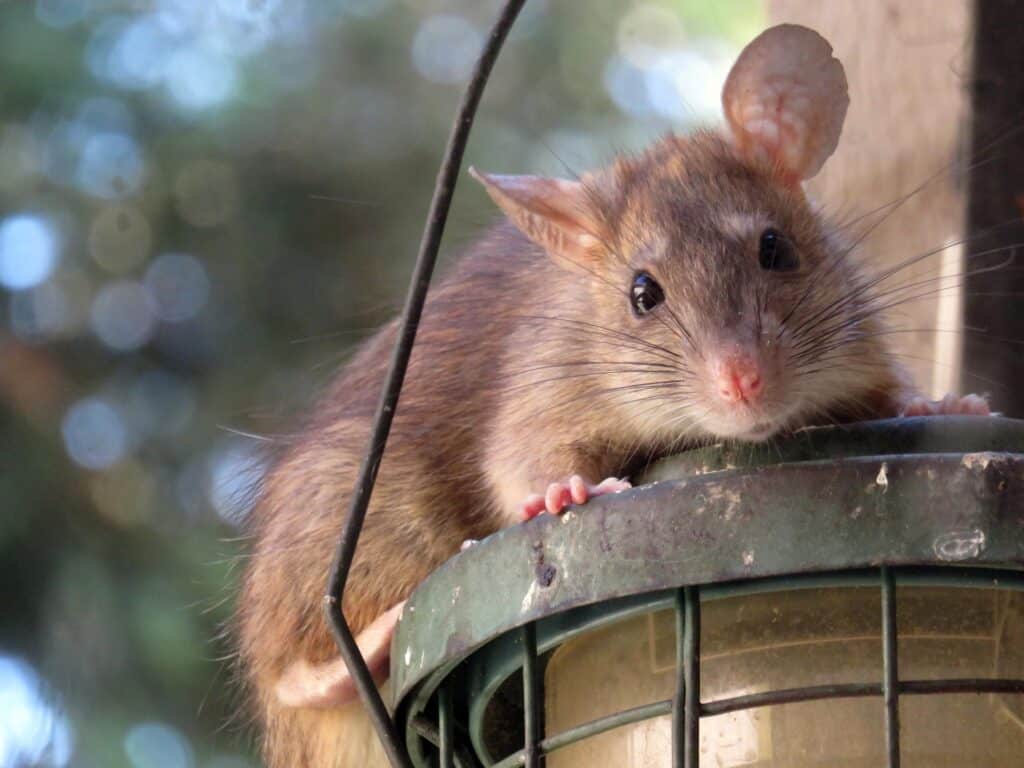
Rats can be seen moving confidently through dark cluttered spaces or along complex routes despite not being able to see clearly, suggesting they navigate using senses beyond vision.
Rats and other rodents have relatively poor eyesight—they see the world as blurry and flat with limited color perception, requiring close proximity to recognize objects clearly—yet demonstrate exceptional navigation through other highly-developed senses including ultra-sensitive whiskers.
Understanding why rats have poor eyesight yet navigate effectively explains their movement patterns within structures, reveals what sensory cues they rely on for getting around, and informs rodent control strategies that work with their actual behavior. The way rats use multiple senses together shows remarkable adaptation to living in dark underground environments.
Why Rats Rely on Their Bodies More Than Their Eyes
Rats see much differently than humans, with several visual limitations reflecting their evolution as creatures that primarily operate in darkness and underground burrows.
- Blurry vision: Rats see the world as significantly blurred compared to human vision—roughly equivalent to what humans with 20/600 vision experience. They can only see fine details of objects within a few inches of their face, while everything beyond that range appears increasingly fuzzy and indistinct.
- Limited colors: Unlike humans who see the full rainbow of colors, rats perceive a much more limited color palette. They see blues and greens but can’t see reds at all, making their color world similar to someone with red-green colorblindness where many colors appear as different shades of yellow-blue.
- Flat appearance: Rat eyes sit on the sides of their heads rather than facing forward like ours, which gives them a wide view for detecting predators but makes judging distances difficult. They have much less depth perception than humans, making their world appear flatter and making it harder to judge how far away things are.
- Near-sighted focus: Rats are naturally near-sighted, with their vision optimized for examining things close-up rather than seeing distant objects. This makes sense for animals that evolved living in underground burrows where long-distance vision doesn’t help much but being able to examine tunnel surfaces and food up close proves essential.
Poor Eyesight Doesn’t Slow Rats Down
Rats have highly developed whisker systems that provide detailed information about their surroundings through touch, working almost like vision does for animals with good eyesight.
Whisker design: Rats have about 30 large whiskers on each side of their face, plus smaller ones above their eyes and on their chin. These specialized hairs extend nearly two inches from their faces, creating a detection zone well beyond what they can touch directly with their bodies. Each whisker connects to highly sensitive receptors that send precise information to the brain about position and movement.
Active sensing: Rather than just bumping into things passively, rats actively sweep their whiskers forward and back 5-15 times per second while exploring. This continuous sweeping generates a stream of information about nearby surfaces, objects, and spaces, with the sweeping pattern adjusting based on how complex the environment is.
Building mental pictures through touch: Whisker contacts create detailed mental representations of three-dimensional spaces including surface textures, where objects are located, how wide gaps are, and how things relate spatially. Rats can accurately judge whether openings are big enough for their bodies just by feeling with their whiskers, navigate complex paths in complete darkness, and detect tiny differences in surface texture.
How Rats Get Around
Understanding how rats navigate explains their movement patterns within structures and helps explain why they behave the way they do indoors.
Predictable paths: Since rats rely on touch cues and movement habits, they create highly-predictable travel patterns along structural elements—baseboards, joists, pipes, wire chases—where they can maintain consistent surface contact for their whiskers. This concentrates their activity along specific routes making these areas ideal for detection and control efforts.
Darkness doesn’t slow them down: Poor eyesight creates no disadvantage in dark attics, wall spaces, or crawl spaces. Rats navigate these areas as effectively as lit spaces through their whiskers, smell, and movement memory, explaining why they’re so successful at colonizing dark building interiors where other animals struggle.
Reluctance to change routes: While their spatial memory helps them navigate efficiently, it also makes them suspicious of unfamiliar objects or changes along their established routes. This explains why they initially avoid new traps and why disrupting their environment (moving stored items, altering structures) can temporarily disrupt their activity.
Rats Show Strong Problem-Solving Skills
Beyond what they’re sensing right now, rats build sophisticated mental maps of their environments that let them navigate flexibly, find shortcuts, and create new routes to reach their goals.
- Building mental maps: When rats explore new areas, they rapidly build mental pictures encoding how locations, landmarks, and resources relate spatially to each other. These mental maps are flexible—rats can reach goals through multiple routes, take shortcuts when familiar paths get blocked, and navigate toward remembered locations from new starting points, showing they genuinely understand space rather than just memorizing turns.
- Brain’s GPS system: Neuroscience research shows rat brains contain specialized “place cells” that fire when rats are in specific locations, collectively creating neural maps of environments. These cells update based on what rats sense and how they move, maintaining current location estimates—like an internal GPS providing continuous position information.
- Tracking their own movement: Rats keep track of their own motion through internal body signals, letting them estimate their current position by mentally calculating where they are relative to where they started based on distance and direction traveled. This lets them take direct return routes home even through paths they’ve never traveled before.
Professional Help to deal with Rat Skills
Professional pest control includes thorough inspection identifying their travel routes and activity centers, strategic placement of traps based on their navigation patterns, sealing work preventing access, and sanitation guidance eliminating food sources and scent trails.
If you’re hearing sounds suggesting rat activity, discovering rat droppings or gnaw marks, or concerned about potential problems, contact Aptive today for a free quote and professional advice from a quality pest control service.