Call now and ask about our Summer Offer

Phone Icon
Phone Icon
Phone Icon
Phone Icon

(855) 948-5816

Aptive Pest Control Logo

The Essential Guide to Scorpions: Facts, Behaviors & Identification Tips

Learn how to identify scorpions, spot signs of activity, and understand their behavior with our knowledgeable approach, so you can protect your home and family with confidence.

ORDER SCORPIONES

Scorpions facts every homeowner should know

Scorpions are arachnids, not insects

Despite their intimidating look, scorpions are closely related to spiders, ticks, and mites, not insects. They have eight legs, a pair of front pincers called pedipalps, and a segmented tail that curves over the back and ends in a venomous stinger. Of the approximately 70 scorpion species found in North America, more than 40 of them live in the United States and are mostly concentrated in warmer, drier states.

Nocturnal habits keep them hidden

Scorpions are primarily active at night. During the day, they hide under rocks, wood, boards, and debris, emerging after dark to hunt insects. That nocturnal pattern is why most homeowners only spot them at night, usually near foundations, garages, or bathrooms.

Most stings cause only mild symptoms

Most North American scorpion stings cause mild symptoms – such as localized tingling, burning, or swelling (similar to a bee sting) – that often resolves within a few hours. The Arizona bark scorpion, common in the desert Southwest, is the main exception – and its sting can cause more serious reactions, particularly in young children or older adults.

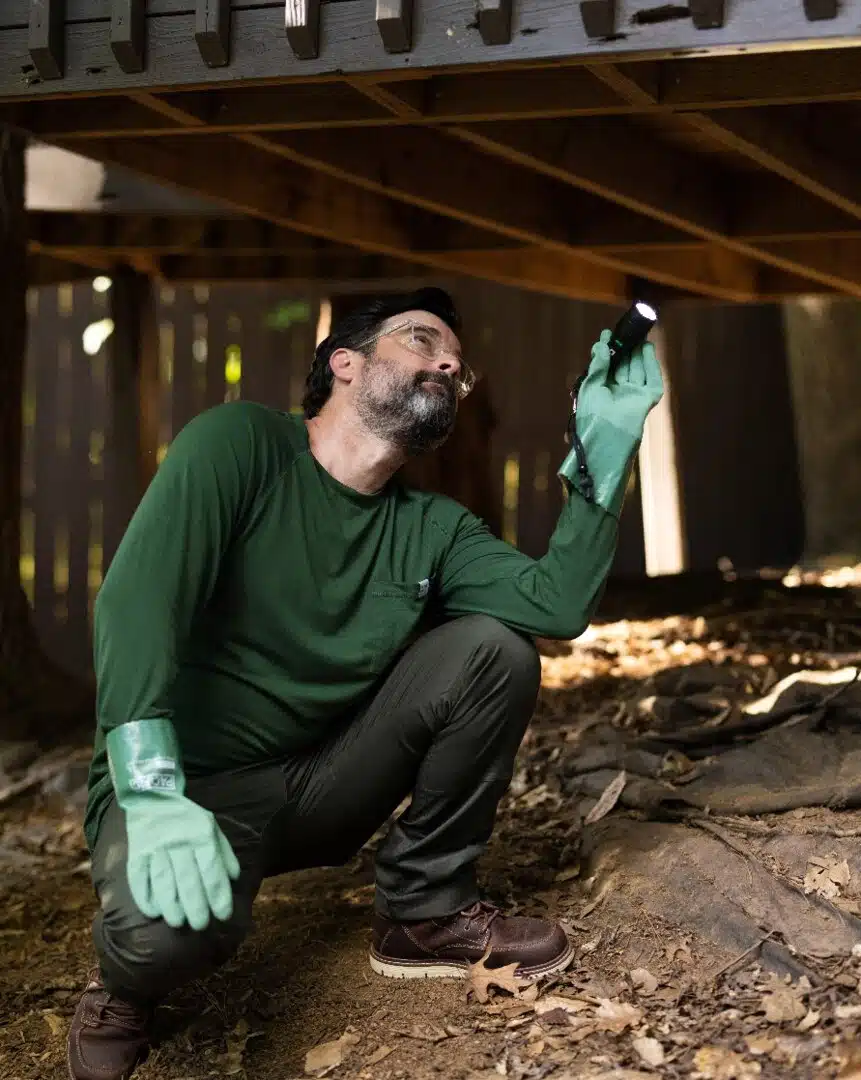
Pest Expert with Homeowner

scorpion treatment

How we handle scorpion control

Aptive’s trained Service Professionals treat exterior walls around the foundation, entry points around doors and windows, and other likely access spots, then tailor the plan to the conditions of your specific property.

We’re dedicated to giving you peace of mind and helping you enjoy your home again. For specialized scorpion pest control, find a location near you and let our Service Pros build a plan around your property.

Nearly 98% of scorpion sting cases analyzed using the National Poison Data System happen inside the home*.

If you’re dealing with scorpions in your home, give Aptive a call and let our team help you take your space back.

*Source: Journal of Medical Toxicology, University of Arizona College of Medicine, Phoenix

Identifying Scorpions

What do scorpions look like?

Most scorpion species in the U.S. are two to four inches long and range in colors spanning sandy tan, yellowish brown, and dark brown. Their body has two main segments: a broad cephalothorax up front and a long, segmented abdomen ending in a curved tail with a stinger. Two large pincers extend from the front, giving them their distinctive silhouette.

One useful detection tip: scorpions glow under ultraviolet light. Scanning walls, entry points, and outdoor harborage with a UV flashlight after dark can reveal scorpions that would otherwise go unnoticed, though a newly molted scorpion may not fluoresce until its exoskeleton hardens.

Signs of scorpions in your home

Catching these signs of scorpions early makes it easier to take action.

  • Nighttime sightings: Scorpions are most active after dark, often turning up near foundations, garages, bathrooms, and laundry areas where moisture is present.
  • Daytime harborage: Finding a scorpion under rocks, wood piles, leaf litter, or debris during the day suggests an established population nearby.
  • UV flashlight scans: A quick sweep with an ultraviolet flashlight along exterior walls and entry points can reveal scorpions that blend in during daylight.
  • Insect prey nearby: Scorpions feed on crickets, cockroaches, and other insects, so a noticeable insect population around your home can attract and sustain scorpion activity.

If you’re noticing more than one of these signs, it’s recommended that you have a professional take a closer look before the population grows.

What attracts scorpions?

Scorpion infestations typically trace back to a few common attractants:

  • Harborage: Wood piles, leaf litter, mulch, rocks, and clutter give scorpions and their prey a place to hide. Keeping these materials away from the foundation helps make a property less hospitable to them.
  • Food sources: Scorpions follow their prey, so an active population of crickets, cockroaches, or other small insects can sustain scorpion activity on a property.
  • Moisture and cool shelter: In hot, dry climates, scorpions seek out cooler, damp spaces. Leaky pipes, irrigation systems, and humid crawl spaces can draw them closer to a home.
  • Entry gaps: Gaps around doors, thresholds, windows, and utility lines give wandering scorpions a way inside, especially during temperature swings.

How to get rid of scorpions?

Reducing scorpion activity starts with limiting what draws them in:

  1. Seal entry points: Sealing gaps around doors and utility lines is one of the simplest ways to keep scorpions from wandering inside. Weatherstrip doors and windows, caulk foundation cracks, and install door sweeps.
  2. Reduce harborage: Move wood piles, stones, and debris away from the home. Clear leaf litter and trim vegetation that touches exterior walls.
  3. Manage insect prey: Reducing crickets, cockroaches, and other insects helps limit the food supply that supports scorpions.
  4. Consider professional treatment: A professional plan targets the areas scorpions actually use around a property – foundations, entry points, and harborage zones – for more consistent, longer-lasting coverage than a single round of treatment.

scorpion FAQs

  • How many scorpion species live in North America?
  • Are scorpions dangerous?
  • Where do scorpions live?
  • What should you do immediately after a scorpion sting?

Contact us.

Aptive has scorpion control experts in a city near you. Call us anytime.

scorpion control near me

Aptive has local scorpion control experts ready to serve you. Search for your zip code to find a branch in your area.

Get a quote

Aptive is here to help you build a personalized scorpion control plan based on your needs.

Take back your home with scorpion control today.