You observe beetle damage to lawns, ornamental plants, or fruit wondering which species causes problems and how to distinguish between similar-appearing beetles. Green June bugs (Cotinis nitida) and Japanese beetles (Popillia japonica) differ through multiple characteristics including adult size with green June bugs measuring 20-25mm versus smaller 10-12mm Japanese beetles.
Understanding differences between green June bugs vs Japanese beetles enables accurate identification determining which species affects properties, informs species-appropriate control timing and methods, and reveals distinct damage patterns each creates, requiring tailored beetle control approaches. While both species demonstrate similar life cycles with soil-dwelling grubs and summer-active adults, their specific behaviors and impacts differ substantially.
What Are Green June Bugs?
Green June bugs represent native North American scarab beetles demonstrating distinctive characteristics enabling identification and understanding their damage patterns and seasonal activity.
- Adult appearance and size: Adult green June bugs measure 20-25mm (approximately 1 inch) length making them substantially larger than many garden beetles. Their dorsal surfaces display brilliant metallic green coloration with bronze, gold, or yellowish margins along wing cover edges creating distinctive iridescent appearance in sunlight. Ventral surfaces show pale green to yellowish coloration, and bodies bear numerous short stiff setae (hairs) particularly on legs and undersides. Flight produces loud buzzing sounds often compared to bumblebees given their large size and wing beat frequency.
- Larval characteristics: Green June bug grubs demonstrate distinctive morphology and behavior differing from typical scarab grubs. They measure 35-50mm when mature, show creamy-white coloration with brown head capsules, and possess short legs near anterior ends. Uniquely among common lawn grubs, green June bug larvae crawl on their backs using dorsal setae and body undulations for locomotion rather than the typical C-shaped crawling position other scarab grubs employ.
- Life cycle timing: Adult beetles emerge from soil in mid-to-late summer (typically June through August depending on region and seasonal temperatures) when soil temperatures and moisture trigger emergence. Females oviposit (lay eggs) in soil with high organic matter content, eggs hatch within 2-3 weeks, and grubs develop through fall and winter remaining active when soil temperatures permit. Pupation occurs in late spring with adults emerging following summer warm-up, completing the annual single-generation cycle.
- Habitat preferences: Green June bugs favor areas with abundant organic matter including composted materials, mulched landscapes, and areas with decaying plant debris. Adults demonstrate strong attraction to fermenting or overripe fruit particularly peaches, plums, figs, and other soft stone fruits. They’re commonly observed in agricultural areas with fruit production and residential landscapes with fruit trees.
- Feeding behaviors: Adult green June bugs feed primarily on overripe or damaged fruit consuming soft fermented portions, tree sap flows from wounds or pruning cuts, and occasionally flower petals. Grubs consume decaying organic matter in soil including decomposing roots, compost, and various organic debris rather than primarily feeding on living healthy roots like many scarab grubs.
- Geographic distribution: Green June bugs occur throughout southeastern and south-central United States from Florida west to Texas and north to Kansas and Virginia, with populations concentrated in warmer humid regions. Their range reflects requirements for relatively mild winters enabling grub survival and warm summers supporting adult activity.
What Are Japanese Beetles?
Japanese beetles represent invasive Asian scarab beetles introduced to North America in the early 1900s, demonstrating aggressive feeding behaviors and wide host plant range creating significant pest status.
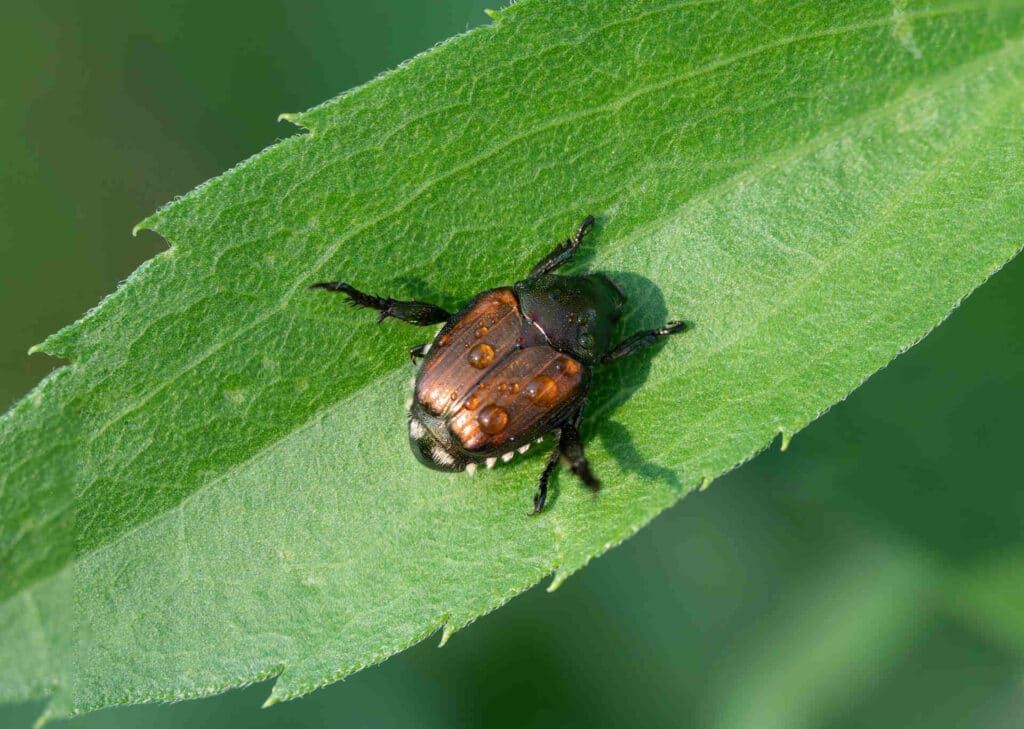
- Adult appearance and diagnostic features: Adult Japanese beetles measure 10-12mm length—roughly half the size of green June bugs. Their heads and thoraxes display metallic green coloration while wing covers (elytra) show distinctive metallic copper or bronze coloration creating striking color contrast. Most diagnostically, they possess five patches of white setae (hair tufts) along each side of the abdomen visible from above plus one additional pair near the abdominal tip—these white tufts provide reliable identification distinguishing them from similar beetles.
- Larval characteristics: Japanese beetle grubs appear typical of scarab larvae measuring 25-30mm when mature, showing creamy-white coloration with brown head capsules and well-developed legs. They assume a characteristic C-shaped resting position typical of most white grubs. Definitive grub identification requires examining the rastral pattern (spine arrangement on last abdominal segment) showing V-shaped configuration diagnostic for Japanese beetles versus Y-shaped or other patterns in related species.
- Life cycle and seasonal activity: Japanese beetles demonstrate annual single-generation cycles in most regions. Adults emerge from soil in early-to-mid summer (typically late May through July depending on latitude and season) with emergence triggered by soil temperature and moisture. Adults live 4-6 weeks during which they feed intensively, mate, and females oviposit 40-60 eggs in turf soil 50-100mm deep. Eggs hatch in 10-14 days, grubs feed on roots through late summer and fall, then burrow deeper (150-250mm) for winter. In spring, grubs migrate upward resuming feeding before pupating in May-June.
- Host plant range: Japanese beetles demonstrate extraordinarily broad host range attacking over 300 plant species. Preferred hosts include roses, grapes, linden, crape myrtle, birch, Japanese maple, various fruit trees, vegetables including beans and corn, and numerous ornamental flowers. This polyphagy (feeding on many species) distinguishes them from more-specialized beetles and contributes to their pest status.
- Feeding damage characteristics: Adult Japanese beetles create distinctive “skeletonizing” damage consuming leaf tissue between veins leaving a lace-like appearance with intact vein network. They often feed gregariously with dozens to hundreds of beetles aggregating on favored plants creating severe rapid defoliation. Flowers receive similar treatment with beetles consuming petals and reproductive structures. Grubs feed on grass roots causing turf thinning, browning, and in severe cases complete turf death in irregular patches.
- Aggregation behavior: Japanese beetles demonstrate strong aggregation pheromones attracting additional beetles to feeding sites. Initial colonizers release volatile compounds signaling food source presence bringing more beetles in positive feedback creating the dense feeding clusters characteristic of this species. This aggregation behavior amplifies damage beyond what individual feeding would create.
- Geographic distribution and spread: Japanese beetles were first detected in New Jersey in 1916, likely arriving in soil around imported plant roots. They’ve since spread throughout the eastern and midwestern United States from Maine to Georgia west to Kansas and Iowa, with isolated populations in western states. Their spread continues though regulatory programs attempt limitation through quarantines on plant material movement from infested areas.
Comparative Life Cycle and Seasonal Activity
While both species demonstrate similar general scarab life cycles with soil-dwelling grubs and summer-active adults, specific timing and requirements differ creating distinct management windows.
- Emergence timing differences: Japanese beetles typically emerge earlier (late May through July peak) compared to green June bugs’ mid-to-late summer emergence (June through August peak). This timing difference means Japanese beetle damage often precedes green June bug issues by several weeks, with Japanese beetles attacking spring growth while green June bugs impact mid-to-late summer fruit.
- Grub activity seasons: Both species’ grubs remain active during fall feeding on roots or organic matter then overwinter in soil. However, green June bug grubs demonstrate greater cold tolerance remaining active at lower temperatures compared to Japanese beetle grubs that cease feeding earlier and burrow deeper. Spring activity resumes earlier for Japanese beetle grubs (March-April) versus green June bugs (April-May) affecting optimal grub control timing.
- Adult longevity: Individual Japanese beetle adults live 4-6 weeks while green June bug adults may persist 6-8 weeks, though population-level adult presence extends longer as emergence occurs over several weeks for both species. This prolonged emergence means control measures must account for continuous new adult appearance rather than single synchronized cohort.
- Reproductive capacity: Female Japanese beetles lay 40-60 eggs over their lifetimes in multiple oviposition events, while female green June bugs produce fewer eggs (typically 20-40) but in soil with higher organic matter potentially improving larval survival. Both species produce single annual generations in most regions though warmer areas may support partial second generations.
Prevention and Long-Term Management
Sustainable management reducing reliance on repeated insecticide applications requires integrated approaches addressing multiple factors supporting beetle populations.
Landscape plant selection: Choosing plants less-preferred by Japanese beetles for new plantings reduces future damage potential. Resistant or less-attractive species include boxwood, red maple, flowering dogwood, holly, magnolia, and many others documented in extension publications. While some sacrifice of preferred species may occur, overall landscape beauty and function can be maintained while reducing pest pressure.
Soil health management: Maintaining soil organic matter through composting and organic amendments provides benefits but may attract green June bugs. Balancing soil health goals with pest management may require strategic organic matter placement away from valued turf areas or acceptance of minor green June bug presence. For Japanese beetles, avoiding drought stress through appropriate irrigation maintains plant vigor enabling compensation for moderate feeding damage.
Monitoring and threshold-based management: Regular inspection of susceptible plants during beetle flight periods enables early damage detection. Establishing damage thresholds—levels of injury tolerated before treatment—prevents unnecessary applications while still protecting high-value plants. Small beetle populations may be tolerated on large vigorous plants while concentrated feeding on prize roses warrants intervention.
When to Call a Professional Pest Control Service
A professional pest control service can help implement a comprehensive program including proper identification confirming target species, strategic grub control timing for optimal effectiveness with minimal environmental impact, adult control as needed protecting high-value plantings, and monitoring confirming management success enabling program adjustments.
If you’re observing beetle damage to ornamental plants or turf, uncertain whether you’re dealing with green June bugs or Japanese beetles requiring accurate identification, or experiencing severe damage requiring professional pest control intervention, contact Aptive today for a free quote and professional evaluation.