You notice beetles consistently gathering around your porch lights, flying erratically near indoor lamps, or accumulating on illuminated windows during evening hours, creating persistent pest problems that seem directly connected to your lighting choices. This phenomenon reflects complex evolutionary adaptations and neurological responses that artificial lighting disrupts, causing beetles to exhibit behaviors that appear purposeful but actually represent navigation system malfunctions.
These insects demonstrate species-specific responses to different light wavelengths, intensities, and temporal patterns that influence their establishment and activity levels in residential environments.
What Happens in the Natural World?
Beetle light attraction results from millions of years of evolutionary adaptation to natural light sources that enabled navigation, temporal orientation, and predator avoidance in pre-industrial environments.
Beetles evolved sophisticated visual systems that utilize consistent celestial light sources including the sun, moon, and stars for directional orientation during flight and ground movement, enabling accurate navigation across complex terrain.
Natural light cycles provide essential cues for circadian rhythm regulation, seasonal activity timing, and reproductive behavior synchronization that optimize survival and reproductive success in natural environments.
Beetle visual systems feature compound eyes with thousands of individual photoreceptors (ommatidia) specifically adapted to detect light intensity, polarization patterns, and wavelength variations that facilitate navigation and behavior timing.
Light detection triggers specific neural pathways that influence flight direction, activity timing, and habitat selection through complex interactions between visual input and behavioral response systems.
Why Beetles React to Indoor Lighting
Modern artificial lighting creates unprecedented environmental conditions that overwhelm beetle navigation systems and trigger maladaptive behaviors leading to indoor invasions and population concentration.
Artificial light sources emit constant, stationary illumination that confuses beetles adapted to use moving or distant celestial bodies for navigation, causing circular flight patterns and disorientation responses.
High-intensity artificial lights create visual illusions and contrast effects that interfere with normal depth perception and distance assessment capabilities, leading to collision and entrapment behaviors.
Artificial lighting often emits wavelength combinations and intensities that differ significantly from natural light sources, triggering inappropriate behavioral responses based on evolutionary programming.
Continuous nighttime illumination disrupts normal circadian rhythms and activity patterns, causing beetles to remain active during periods when they would naturally seek shelter.
Which Beetles Are Found Indoors?
Different beetle species demonstrate varying degrees of phototaxis and wavelength sensitivity based on their ecological niches, activity patterns, and evolutionary history.
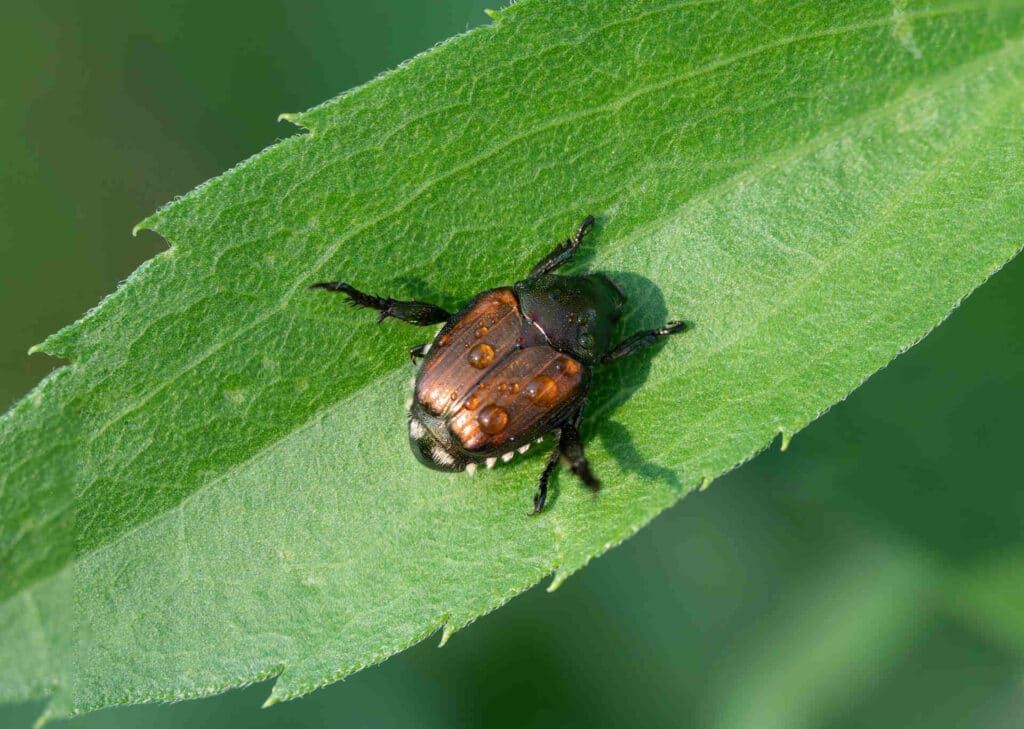
- Strongly phototactic species: June beetles (Phyllophaga spp.) and many scarab beetles demonstrate pronounced attraction to artificial lighting, particularly UV-rich sources, leading to massive aggregations around illuminated areas during peak activity periods.
- Moderately responsive species: Carpet beetles (Anthrenus spp.) and click beetles (Elateridae) show moderate light attraction that increases during dispersal periods and mating flights, with responses varying based on light intensity and environmental conditions.
- Light-neutral species: Ground beetles (Carabidae) and many rove beetles (Staphylinidae) demonstrate minimal phototactic responses, though they may be indirectly attracted to illuminated areas where prey species concentrate.
- Negatively phototactic species: Many darkling beetles (Tenebrionidae) and some stored product beetles actively avoid bright lighting, though they may still enter illuminated buildings through structural gaps during normal movement patterns.
How Lighting Shapes Beetle Activity
Multiple environmental variables interact with lighting to determine beetle attraction intensity and indoor invasion success rates.
- Seasonal activity cycles: Beetle light attraction varies significantly with seasonal emergence patterns, reproduction timing, and environmental conditions that influence adult activity levels and dispersal behaviors.
- Weather condition influences: Temperature, humidity, and atmospheric pressure affect beetle flight capability and light sensitivity, with optimal flying conditions increasing phototactic response intensity.
- Competition and resource availability: Outdoor resource scarcity can intensify light attraction as beetles expand search behaviors and explore new habitat opportunities including illuminated indoor spaces.
- Population density: High outdoor beetle populations increase the probability of light-attracted individuals discovering and exploiting indoor environments through increased contact rates with artificial lighting.
- Time-of-night variations: Beetle light attraction typically peaks during specific evening hours when natural activity cycles coincide with artificial lighting operation, creating predictable invasion timing patterns.
What Homeowners Should Know
When beetle problems persist despite lighting modifications, Aptive’s pest control experts provide the comprehensive solutions necessary for lasting results for beetle control. Our pest control service performs detailed assessment of beetle behavior to identify attraction factors, species-specific responses, and environmental conditions driving continued indoor invasions related to artificial lighting.
If you’re experiencing persistent beetle problems related to outdoor lighting, discovering recurring indoor invasions during evening hours, or need professional assessment of pest or beetle issues, contact Aptive today for a free quote.