You observe jumping spiders demonstrating precise visual tracking behaviors including head movements following your motion and apparent examination of objects from multiple angles, suggesting sophisticated visual processing capabilities beyond simple motion detection.
Jumping spiders (family Salticidae) possess exceptional color vision among arthropods through specialized principal eyes containing multi-layered retinas separating incoming light into distinct wavelength channels—primarily detecting green (500-600nm) and ultraviolet (300-400nm) wavelengths—enabling discrimination of colors, patterns, and UV-reflective features invisible to humans while providing visual acuity approaching some vertebrate species despite eyes measuring just 0.5-2mm diameter.
How Their Eyes Are Built
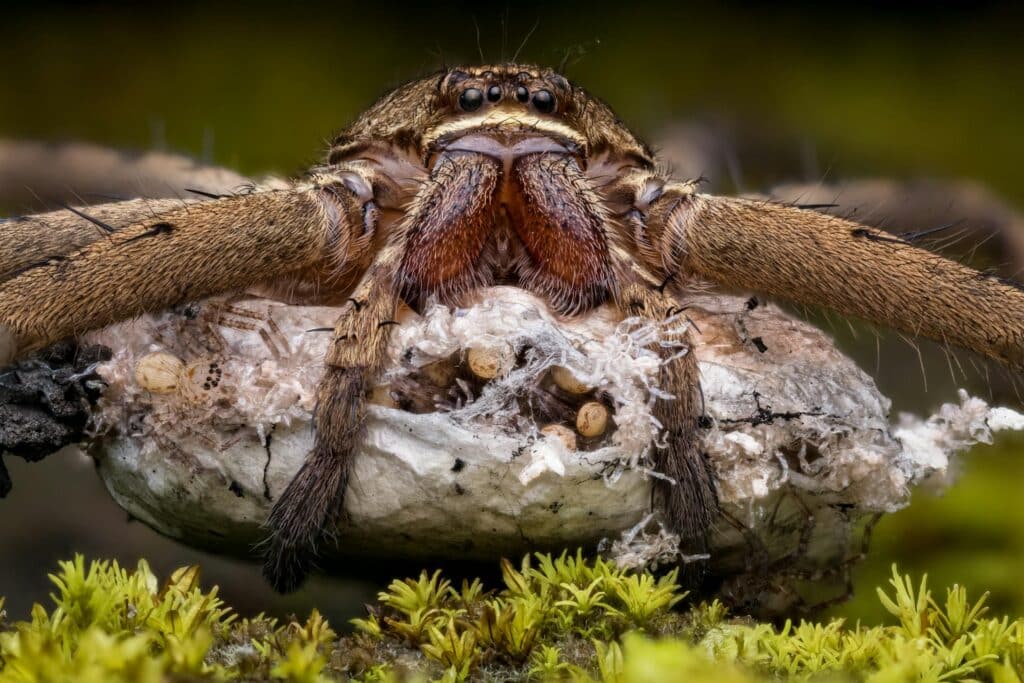
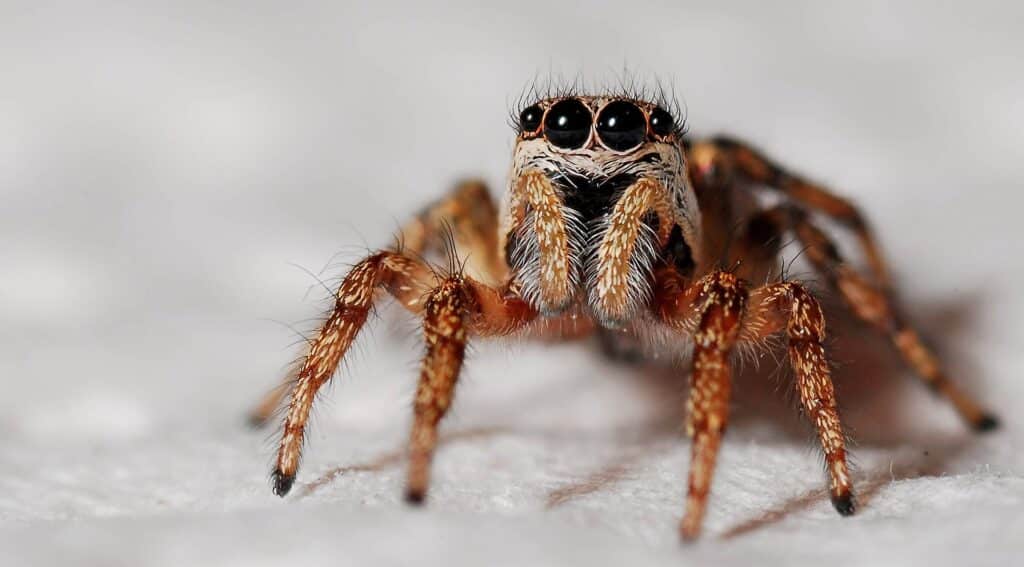
Jumping spiders possess eight eyes arranged in characteristic patterns providing nearly 360-degree visual coverage through combination of different eye types serving complementary functions.
- Principal eyes (anterior median): The two large forward-facing eyes dominate the “face” measuring 0.5-1.5mm diameter depending on species, containing unique tube-shaped internal structures with movable retinas enabling scanning across visual fields without external eye movement. These eyes provide high-resolution color vision and depth perception essential for hunting and navigation.
- Secondary eyes: Six smaller eyes arranged around the head (anterior lateral, posterior median, posterior lateral) detect motion, provide wide-field surveillance, and contribute to depth perception through parallax. While lacking the resolution of principal eyes, secondary eyes alert spiders to movement across nearly complete spherical coverage triggering orientation responses positioning principal eyes toward stimuli.
- Eye placement variation: Different jumping spider species demonstrate characteristic eye arrangements reflecting ecological specializations—open-habitat species often possess larger principal eyes optimizing long-distance prey detection while forest-floor species show relatively smaller eyes adapted to close-range hunting in cluttered environments.
- Retinal structure: Principal eye retinas contain four photoreceptor layers stacked vertically within elongated tube structures, with deepest layers detecting green wavelengths (500-600nm) and superficial layers responding to ultraviolet (300-400nm). This layered organization enables wavelength discrimination through differential stimulation of photoreceptor tiers.
- Moveable retinas: Unlike most arthropod eyes with fixed photoreceptor arrays, jumping spider principal eye retinas attach to muscles enabling scanning movements within eye tubes, providing ~10-degree scanning range compensating for narrow principal eye fields (approximately 5-degree visual angle) without moving the entire body or head.
Seeing the Invisible
Jumping spiders achieve color vision through opponent processing comparing signals from different photoreceptor layers, similar in principle to human trichromatic vision though utilizing different wavelength channels.
Principal eye photoreceptors demonstrate peak sensitivity in green (approximately 535nm) and ultraviolet (approximately 360nm) wavelengths, with some species possessing additional photoreceptor classes providing extended spectral sensitivity. This differs from human vision based on red, green, and blue photoreceptor types but enables similar color discrimination capabilities within spider-relevant wavelength ranges.
Color perception emerges from neural comparison between photoreceptor layer responses, with green versus UV signal ratios enabling discrimination of different spectral compositions. Objects reflecting both wavelengths appear different from those reflecting only green or only UV, creating color distinctions guiding behavior.
The multi-layered retinal structure may also contribute to depth perception through chromatic aberration—different wavelengths focusing at different depths within eye tubes—with focus differences providing distance information supplementing parallax cues from binocular principal eye overlap.
While lacking red sensitivity (unlike humans perceiving 400-700nm), jumping spiders detect wavelengths from approximately 300-650nm, with UV sensitivity extending perception into wavelength ranges invisible to humans revealing environmental features and biological signals inaccessible to human vision.
Color Vision and Hunting Strategy
Jumping spider hunting demonstrates integration of motion detection, color discrimination, depth perception, and rapid decision-making enabling successful prey capture without web construction.
Secondary eyes detecting motion across wide visual fields trigger orientation responses positioning principal eyes toward movement sources. Once oriented, principal eyes provide detailed color and pattern information enabling prey versus non-prey discrimination—distinguishing potential food items from wind-blown debris or non-palatable organisms.
Following prey detection, jumping spiders demonstrate characteristic stalking where they maintain visual fixation while slowly approaching, periodically stopping to reassess prey position and distance. Color and pattern recognition during stalking may enable prey identity determination influencing attack decisions (avoiding dangerous prey like wasps).
Binocular principal eye overlap creates stereoscopic depth perception, with additional depth cues potentially from retinal focus differences (closer objects creating greater chromatic aberration) and learned size-distance relationships based on visual experience. Accurate distance assessment proves critical for successful jumps.
Courtship Display and Communication
Male jumping spiders perform elaborate visual displays during courtship utilizing color patterns, movement sequences, and UV signals evaluated by females making mate selection decisions.
Males approach females while performing species-specific dances including leg waving, body raising, lateral movements, and abdominal signaling—movements emphasizing colorful or UV-reflective body regions. Display complexity varies by species with some demonstrations lasting minutes incorporating dozens of distinct movement elements.
Experimental manipulations reducing male coloration intensity or masking UV-reflective patches demonstrate reduced female receptivity, confirming visual signals’ importance in mate assessment. Males with brighter colors or more extensive UV patches often demonstrate higher mating success suggesting females use these cues evaluating male quality.
Female jumping spiders demonstrate active mate choice rejecting many courting males while accepting others based on display quality, color intensity, and movement precision. This choosiness creates sexual selection pressure driving elaboration of male visual signals and displaying behaviors across evolutionary time.
The Bigger Picture: Vision as Defense
Jumping spiders provide beneficial pest control services through predation on flies, mosquitoes, and other insects while posing no threats to humans, meriting tolerance in most contexts.
- Prey consumption: Individual jumping spiders consume 1-3 prey items daily depending on size and availability, targeting flies, gnats, mosquitoes, small beetles, and other arthropods considered household pests. This predation provides natural biological control reducing pest populations without chemical interventions.
- Non-aggressive nature: Jumping spiders demonstrate no aggression toward humans, with bites occurring only under extreme provocation (direct handling, accidental crushing). Their visual acuity enables predator recognition triggering avoidance rather than defensive behaviors.
- Indoor presence: Jumping spiders occasionally enter structures seeking prey attracted by indoor lighting or while exploring during warm weather. Their presence typically indicates abundant prey insects rather than representing primary pest concerns.
When to Talk to a Professional
Professional pest control approaches recognize jumping spider beneficial roles, implementing management focusing on exclusion, preventing entry and addressing prey insect populations attracting spiders rather than targeting beneficial predators directly.
If you’re observing jumping spiders indoors and concerned about their presence, experiencing general spider problems, or seeking comprehensive spider control balancing management with ecological benefits, contact Aptive today for a free quote and expert evaluation implementing strategies addressing spider activity while preserving beneficial species providing natural pest control services.