You observe spider webs withstanding wind, rain, and prey impacts without breaking despite appearing impossibly delicate, suggesting these structures possess exceptional material properties balancing strength and flexibility.
Spider silk demonstrates remarkable mechanical characteristics including tensile strength of 1,000-1,400 MPa (comparable to high-grade steel), extensibility of 200-400% (stretching 2-4 times original length before breaking), and exceptional toughness (energy absorption capacity) exceeding synthetic materials through molecular architecture combining ordered crystalline regions providing strength with disordered amorphous regions enabling elasticity.
The sophisticated molecular structure of silk represents millions of years of evolutionary refinement optimizing performance for specific ecological functions while minimizing metabolic production costs.
The Secret in Spider Silk’s Structure
Spider silk consists primarily of specialized proteins called spidroins (spider fibroins) demonstrating unique molecular architectures that create mechanical properties unmatched by most natural or synthetic materials.
Spidroin proteins contain 200-350 kilodaltons of molecular weight with repetitive amino acid sequences dominated by glycine, alanine, and serine residues comprising 60-80% of total composition. These amino acids arrange in specific motifs creating characteristic secondary structures determining silk mechanical properties.
Silk contains 10-40% crystalline domains (depending on silk type) where protein chains align in highly ordered beta-sheet structures held together by hydrogen bonds between adjacent chains. These crystalline regions—measuring 2-10 nanometers—provide tensile strength resisting stretching forces through strong intermolecular interactions.
Between crystalline domains exist disordered amorphous regions where protein chains adopt irregular conformations with minimal intermolecular bonding. These flexible regions enable silk extensibility, absorbing energy through chain uncoiling and molecular rearrangement when subjected to tensile stress.
Silk structure demonstrates organization across multiple scales from molecular (protein sequences) through nanoscale (crystalline/amorphous domains) to microscale (protein fiber bundles) creating composite material where different structural levels contribute specific mechanical properties.
Chemical bonds including disulfide bridges between cysteine residues and various non-covalent interactions stabilize spidroin structures, with cross-linking density influencing silk stiffness and extensibility characteristics varying between silk types.
Multiple Silk Types and How They Are Used
Individual spiders produce 2-7 distinct silk types from different glands, each optimized for specific functions through variations in protein composition and molecular structure.
- Major ampullate silk (dragline): Produced by major ampullate glands, this silk forms web framework threads, radial supports, and spider draglines providing structural strength and safety lines. Characterized by high tensile strength (1,000-1,400 MPa) and moderate extensibility (20-40%), with protein composition featuring high alanine content creating strong crystalline regions.
- Flagelliform silk (capture spiral): Synthesized by flagelliform glands, this highly elastic silk forms sticky capture spirals in orb webs, demonstrating extensibility of 200-400% enabling energy absorption from prey impacts. Protein structure features more flexible molecular motifs with fewer crystalline regions compared to dragline silk.
- Aggregate silk (glue): Not technically silk fiber but aqueous adhesive coating flagelliform threads, containing hygroscopic compounds maintaining stickiness across humidity ranges. Glycoproteins in aggregate silk create viscoelastic adhesive demonstrating initial stretching, maintaining prey contact then contracting and securing capture.
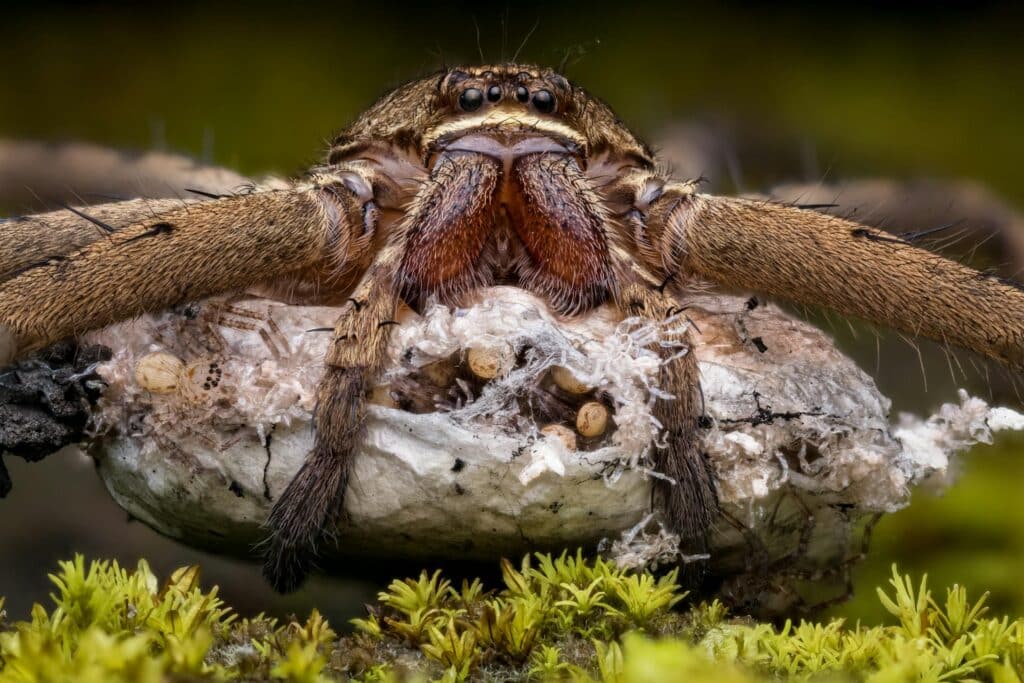
- Aciniform silk (wrapping): Used for prey immobilization and egg sac construction, demonstrating high toughness and moderate strength suitable for containing struggling prey and protecting developing eggs. Multiple fiber strands bundled together create wrapping materials with enhanced durability.
Species-Specific Silk Adaptations
Different spider families demonstrate silk property variations reflecting ecological niches, prey types, and web architectures through evolutionary refinement of spidroin sequences and silk gland development.
- Golden silk orb-weavers: Nephila species produce silk with distinctive golden coloration from incorporated xanthophylls and kynurenines, demonstrating exceptional extensibility (stretching 5+ times original length) enabling capture of large flying insects including beetles and even small birds. Their silk shows highest toughness measurements among studied spider species.
- Garden spiders: Araneus diadematus and related orb-weavers balance strength and extensibility in dragline silk optimized for reconstructed daily webs, with silk properties enabling efficient prey capture across diverse insect sizes while minimizing material investment through recycling.
- Darwin’s bark spider: Caerostris darwini from Madagascar produces silk demonstrating highest measured tensile strength (1,650 MPa) and toughness (350 MJ/m³) among spider species, enabling construction of river-spanning webs up to 25 meters wide capturing flying insects over water surfaces.
- Black widows: Latrodectus species produce particularly strong silk suitable for three-dimensional cobweb architectures capturing crawling and flying prey, with silk demonstrating resistance to damage from larger struggling prey including beetles and even small vertebrates.
- Funnel-web spiders: Agelenidae silk optimized for sheet web construction demonstrates properties suitable for horizontal platforms detecting prey movement through vibrations, with emphasis on durability for long-lasting webs rather than daily reconstruction.
How Spiders Use Flexible Silk to Their Advantage
Silk flexibility and energy absorption properties prove essential for successful prey capture, enabling webs to withstand impact forces that would destroy rigid structures.
Impact absorption: When flying insects strike webs at velocities of 1-5 meters per second, kinetic energy conversion to silk deformation prevents immediate structural failure. Capture spiral extensibility enables local web deformation absorbing 60-80% of impact energy through silk stretching rather than thread breakage.
Prey retention: Following initial impact, elastic silk recoil creates rebounding forces pushing prey deeper into sticky spirals while vibrations alert spiders to capture events. Extended struggling by prey further entangles bodies in silk without causing progressive web damage through accumulated stress.
Size range accommodation: Web architecture combining stiff structural threads (radii) with elastic capture spirals enables retention of prey spanning 100-fold mass ranges, with small insects trapped by individual sticky droplets while large prey encounters distribute forces across multiple radii preventing localized failure.
Vibration transmission: Silk’s mechanical properties enable efficient vibration transmission from prey struggles at web periphery to central hub where spiders await, with signal characteristics (frequency, amplitude, duration) providing information about prey size and vigor guiding spider response behaviors.
Minimal maintenance requirements: Silk durability through multiple prey capture events reduces web reconstruction frequency for permanent web builders, with cobweb spiders maintaining structures for weeks despite accumulated damage from prey captures and environmental stressors.
When to get Professional Help
Professional pest control service providers assess spider species, web types, and silk properties determining appropriate management strategies that balance control needs with recognition of beneficial pest predation services spiders provide. If you’re experiencing persistent spider web accumulation despite regular removal, concerned about spider populations establishing near entry points, or seeking balanced management approaches addressing aesthetic concerns while preserving natural pest control benefits, contact Aptive today for a free quote and comprehensive evaluation with customized spider control solutions appropriate for your specific situation.