When encountering large fast-moving spiders on floors, understanding wolf spider identification, behavior, and habitat preferences is crucial for implementing appropriate responses and recognizing what their presence indicates about household conditions.
Wolf spiders (family Lycosidae) represent a diverse group comprising over 2,000 species worldwide with approximately 200 North American species, characterized by robust ground-dwelling habits, active hunting rather than web-building, excellent vision through distinctive eight-eye arrangement, and rapid movement pursuing prey across floors and outdoor surfaces.
Understanding wolf spider identification enables distinguishing them from other household spiders, reveals that their indoor presence typically indicates prey insect populations attracting them inside, and informs spider control.
What Are Wolf Spiders?
Size and appearance: Wolf spiders demonstrate substantial size variation by species ranging from 10-35mm body length (excluding legs) with total leg span reaching 25-100mm depending on species, making them among the larger spiders homeowners encounter.
Most common household-invading species measure 15-25mm body length, appearing noticeably larger than typical house spiders. Body coloration varies from tan, gray, brown to nearly black with most species displaying mottled patterns including stripes, chevrons, or irregular markings providing camouflage against soil, bark, and leaf litter. Dense body hair (setae) creates a fuzzy appearance contributing to an intimidating impression.
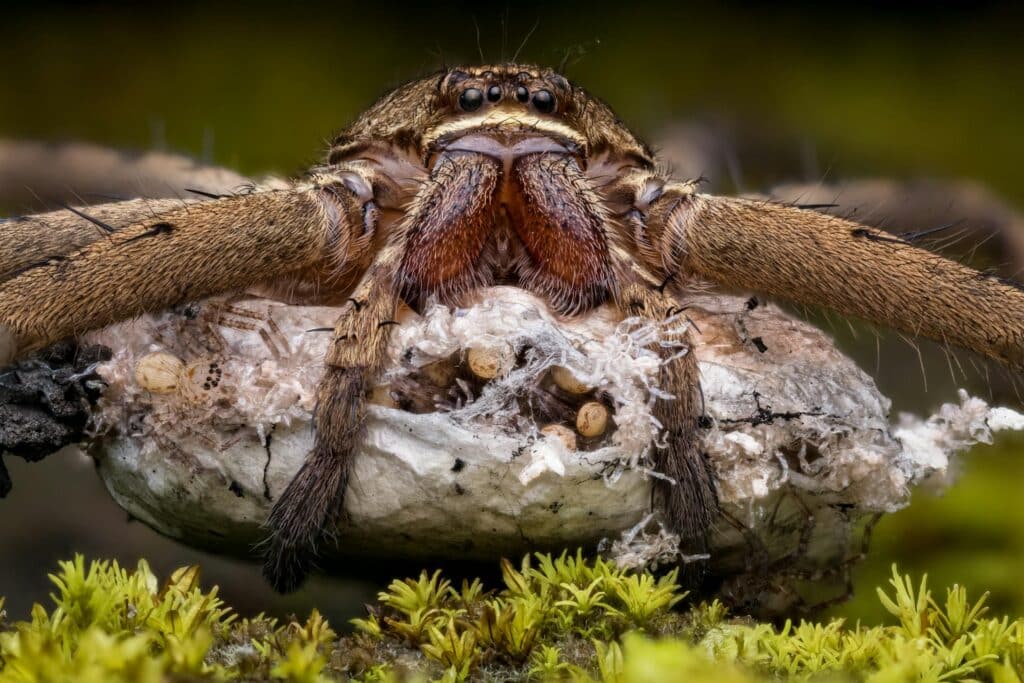
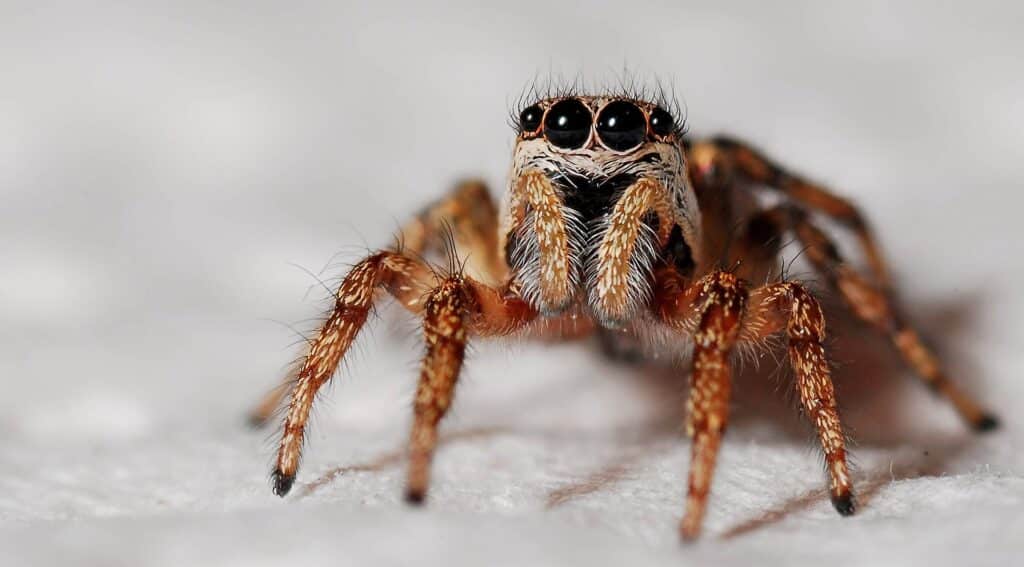
Distinctive eye arrangement: The most-reliable wolf spider identification feature involves eye arrangement with eight eyes in three rows—four small eyes in bottom row, two very large prominent eyes in middle row, and two medium eyes in top row.
The two large forward-facing eyes provide exceptional vision unusual among spiders, reflecting light when illuminated creating an eye-shine effect visible when flashlight beams sweep floors at night. This eye arrangement enables visual prey detection and hunting unlike web-building spiders relying primarily on vibration detection.
Body structure: Wolf spiders possess robust cephalothorax (fused head-thorax region) and oval abdomen creating sturdy powerful appearance. Long strong legs with scopulae (dense hair pads) providing traction enable rapid running across various surfaces. Unlike climbing spiders, wolf spiders lack specialized leg adaptations for vertical surface adhesion restricting them primarily to ground-level activity.
Sexual dimorphism: Males typically appear smaller and more slender than females with proportionally longer legs. Males also possess enlarged pedipalps (appendages near mouth) used during mating appearing like small boxing gloves distinguishing them from females at close examination.
Here’s how wolf spiders compare to common indoor spiders:
| Feature | Wolf Spider | Common House Spider |
| Movement | Fast, ground-hugging | Slow, stays in webs |
| Webs | None | Builds webs in corners or windows |
| Size | 1/2 inch to 2 inches | Usually under 1/2 inch |
| Visibility | Often seen running across floors | Often hidden in webs |
| Behavior | Actively hunts prey | Waits for insects to come to it |
How Wolf Spiders Behave
Hunting strategy: Unlike web-building spiders constructing prey-capture snares, wolf spiders are active cursorial (running) hunters pursuing and pouncing on prey. They rely on excellent vision detecting movement then rapidly chasing down prey including insects, other spiders, and various small arthropods. Some species demonstrate ambush hunting lurking near burrows until prey approaches within striking distance.
Activity patterns: Wolf spiders are primarily nocturnal hunters remaining concealed in retreats during daylight hours emerging at night when prey insects are active. Indoor observations typically occur during evening and nighttime hours when spiders hunt across floors. Their rapid erratic movement patterns startle observers unaccustomed to such fast-moving spiders.
Reproduction and maternal care: Female wolf spiders demonstrate remarkable maternal behavior unusual among spiders. After mating, females construct spherical egg sacs containing 100+ eggs then carry sacs attached to spinnerets (silk-producing organs) at the abdomen rear. Upon hatching, dozens of spiderlings climb onto mother’s abdomen riding piggyback for 1-2 weeks until first molting when they disperse. This maternal care ensures high offspring survival and explains occasional observations of females carrying masses of tiny spiders on their backs creating alarming appearance.
Habitat preferences: Wolf spiders inhabit diverse environments from forests and grasslands to deserts and wetlands, with different species demonstrating habitat specialization. Most prefer ground-level microhabitats including leaf litter, under rocks and logs, in vegetation bases, and in shallow burrows some species excavate. They require adequate prey populations and appropriate shelter from weather and predators.
Seasonal activity: In temperate regions, wolf spider activity peaks during warm months (late spring through fall) when temperatures support hunting and reproduction. Some species overwinter as adults emerging early spring while others overwinter as immatures maturing during warm seasons.
Why Wolf Spiders Come Indoors
Wolf spiders are primarily outdoor spiders not adapted for long-term indoor survival, with indoor observations typically representing temporary incursions rather than established populations.
- Following prey insects: As active hunters, wolf spiders enter structures pursuing prey insects including ants, crickets, beetles, cockroaches, and various other insects inhabiting buildings. Indoor prey populations attract hunting spiders following chemical cues and movement detected through their sensitive vision. Heavy indoor insect activity creates favorable hunting conditions drawing multiple wolf spiders inside.
- Environmental factors: Outdoor environmental changes trigger indoor movement including sudden temperature drops during early fall, heavy precipitation flooding ground-level habitats, extreme heat during summer, and severe drought reducing outdoor prey availability. Structures provide stable moderate conditions and protection from weather extremes.
- Accidental entry: Wolf spiders wandering near building foundations accidentally enter through gaps and openings during nocturnal hunting movements. Common entry points include foundation cracks and gaps, gaps beneath doors particularly garage doors, basement window wells, utility penetrations, and damaged window screens.
- Overwintering behavior: Some wolf spiders seek protected overwintering sites during fall with structures offering suitable conditions. However, most species overwinter outdoors with indoor observations representing accidental intrusions rather than intentional overwintering migration.
Common Areas Wolf Spiders Establish Themselves
When wolf spiders enter structures or inhabit areas immediately around buildings, they concentrate in specific locations matching their ground-level preferences and need for cover.
- Basements and crawl spaces: Cool dark basement areas with minimal human traffic provide ideal wolf spider habitat, particularly areas with clutter, stored items, or accumulated debris providing cover. They remain along walls and in corners rather than open floor centers.
- Garages and sheds: These transition spaces between indoors and outdoors frequently harbor wolf spiders hunting prey insects attracted to these areas. Storage items, equipment, and various materials provide ample hiding locations.
- Ground-level rooms: Wolf spiders entering living spaces remain on ground floors rarely ascending stairs. They’re observed crossing floors between furniture and retreating under couches, chairs, and appliances when disturbed.
- Outdoor perimeter areas: Mulch beds, landscaping materials, firewood stacks, stone walls, dense vegetation, and leaf accumulations immediately adjacent to foundations create favorable wolf spider habitat enabling easy building access.
Are Wolf Spiders Dangerous?
Wolf spiders demonstrate non-aggressive temperament toward humans fleeing when disturbed rather than attacking. Bites occur only when spiders are accidentally trapped against skin in clothing, bedding, or shoes, or when handled directly. They don’t pursue or attack humans unprovoked.
Wolf spider venom is relatively mild producing localized effects including initial sharp pain at bite site, mild to moderate swelling and redness, itching and minor irritation persisting several hours to days, and rarely minor blistering at puncture sites. Symptoms typically resolve without medical intervention within days.
Unlike medically-significant spiders including black widows and brown recluses, wolf spider bites pose minimal health risks to most people. Systemic effects (affecting the whole body) are extremely rare. Severe reactions including allergic responses prove uncommon though individuals experiencing unusual symptoms including spreading swelling, increasing pain, or systemic effects should seek medical evaluation.
Wolf spiders pose minimal risk to pets with bites causing brief discomfort but rarely serious effects. Curious pets investigating or playing with spiders may receive defensive bites producing mild localized reactions. Monitor pets for unusual behavior or symptoms consulting veterinarians if concerns arise.
How to Prevent Wolf Spiders
Effective wolf spider prevention emphasizes exclusion preventing entry and habitat modification reducing attractiveness.
Structural exclusion: Seal foundation cracks and gaps using appropriate caulk or sealant, install or repair door sweeps on exterior doors particularly garage doors, ensure tight window screens without tears or gaps, seal utility penetrations around pipes and wires, and repair damaged weatherstripping around basement windows. Focus exclusion efforts at ground level where wolf spiders access structures.
Perimeter habitat modification: Reduce favorable wolf spider habitat near foundations through removing mulch or creating mulch-free zones immediately adjacent to buildings, storing firewood away from structures on elevated racks, eliminating leaf litter and debris accumulations, trimming vegetation creating cleared zone around foundations, and removing rocks and decorative materials providing harborage adjacent to buildings.
Indoor prey control: Address prey insect populations attracting hunting spiders through maintaining cleanliness, reducing food sources insects exploit, promptly addressing small insect problems before they attract predators, and implementing appropriate insect control when populations warrant intervention.
Lighting management: Reduce outdoor lighting near entry points as lights attract insects that subsequently attract hunting spiders. Use yellow “bug lights” producing wavelengths less-attractive to insects or position lighting away from doors and windows.
Clutter reduction: Minimize indoor clutter particularly in basements, garages, and storage areas reducing hiding locations for both prey insects and hunting spiders.
Pest Control for Wolf Spiders
Direct removal: Individual wolf spiders observed indoors can be removed through capture using containers and released outdoors or vacuuming for immediate elimination. Given their speed, trap containers work better than attempting to squash them.
Residual treatments: When wolf spider observations become frequent suggesting substantial peridomestic populations, perimeter treatments applying residual insecticides to building foundations, entry points, and adjacent areas reduce populations attempting entry. Indoor treatments along baseboards in problem areas provide contact mortality for wandering spiders.
Comprehensive approaches: Effective long-term wolf spider management requires integrated strategies combining exclusion preventing entry, habitat modification reducing favorable conditions, prey insect control eliminating attractants, and when necessary targeted treatments reducing populations.
When to Talk to the Pros
Professional pest control for wolf spiders can address persistent problems through inspection identifying entry points and contributing factors, prey insect assessment and control, appropriate treatment implementation, and follow-up ensuring effectiveness.
If you’re regularly observing wolf spiders indoors suggesting nearby populations and favorable conditions, uncertain about wolf spider identification of observed spiders, or wanting professional assessment and wolf spider prevention strategies, contact Aptive today for a free quote from a quality pest control service.