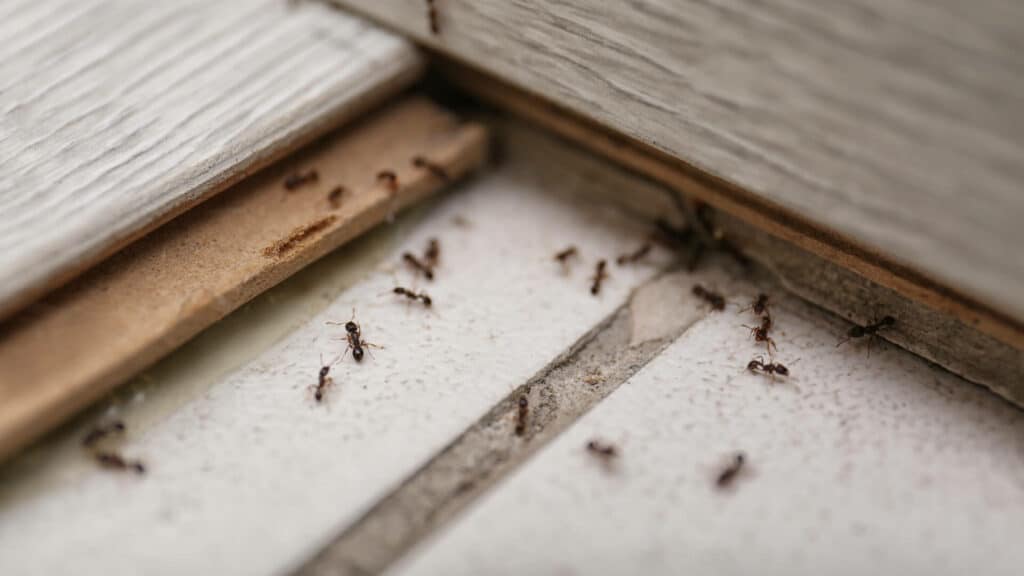
You’ve probably seen ants moving in tight, organized lines or swarming food crumbs without thinking much about what makes them so successful—but there’s a fascinating world of complexity beneath that tiny surface. Ant survival is the result of millions of years of evolutionary refinement, creating hard-coded biological designs and behaviors shaped by environmental pressures, predators, and challenging conditions. Some of these adaptations are subtle and easily overlooked, while others are so unusual they seem almost unbelievable.
If you’ve ever wondered why ants seem almost impossible to eliminate once they establish themselves around your home, understanding these three remarkable biological traits helps explain their extraordinary resilience and persistence.
1. They Build Living Rafts
This isn’t a metaphor or exaggeration—it’s a remarkable survival mechanism observed in nature. Some ant species—especially fire ants—can actually form functioning floating rafts constructed entirely from their own living bodies. When floodwaters rise and threaten their colony, they link together using their powerful jaws and legs to create a surprisingly buoyant structure.
The organization within these living rafts shows remarkable sophistication: the queen is carefully positioned in the middle for maximum protection, worker ants form the outer layers, and the vulnerable larvae are tucked inside specially created pockets of air that help maintain the raft’s buoyancy.
For homeowners, this remarkable adaptation has practical implications. Colonies can effectively migrate during storms or periods of heavy rainfall, allowing them to re-establish themselves in new locations like mulch beds, wall voids, or beneath foundations once the waters recede. This explains why you might suddenly discover ant activity in areas of your property that previously showed no signs of infestation, particularly after significant rainfall events.
2. They Can Handle Heat Most Pests Can’t
The Saharan silver ant represents perhaps the most extreme example of temperature adaptation in the ant world. These remarkable insects can forage in desert conditions with surface temperatures approaching 130°F—conditions that would be lethal to most other arthropods. While this particular species isn’t found in typical North American backyards, it illustrates the extraordinary temperature adaptations that exist within the ant family. Many common household and garden ant species demonstrate similar, if less extreme, heat tolerance that allows them to thrive in conditions that would immobilize or kill other pests.
In the United States, several common ant species demonstrate impressive heat resilience. Pavement ants and Argentine ants can function effectively on scorching hot driveways and patios exposed to direct sunlight, conditions that would drive away most other insects. Their specialized body structure helps them regulate internal temperature even in challenging conditions. Additionally, these heat-tolerant species modify their behavior based on temperature fluctuations—reducing activity during peak heat hours and increasing foraging during the relative coolness of morning or late afternoon hours.
This temperature adaptability explains why ant activity patterns can change so quickly during summer months. You might observe no visible ant activity for weeks, only to suddenly encounter a substantial swarm overnight when temperature and humidity conditions align perfectly for their foraging preferences. This variability makes predicting and controlling ant activity particularly challenging for homeowners trying to manage infestations.
3. They Communicate Through Chemical Trails
Perhaps the most observable ant adaptation is their remarkable communication system based on chemical signaling. When you see ants moving in an organized line, you’re witnessing them following precise paths laid down through pheromones. Different chemical compounds convey specific messages: danger alerts, food locations, routes home, and colony disruption warnings. Each scent carries specific information that other ants decode instantly as they encounter it.
This system significantly enhances their survival: when a worker ant discovers a resource—like that sticky spill under your refrigerator—it deposits a chemical trail on its return journey. Other ants follow this invisible path, reinforcing it with their own pheromones. The colony’s problem-solving abilities become apparent when conditions change.
If food sources disappear or paths become blocked, they quickly adapt by exploring new directions and establishing alternative routes. This explains why conventional ant control methods often prove frustrating—eliminating one visible trail simply results in the rapid establishment of new pathways through their distributed biological intelligence.
Effective Ant Control for Homeowners
These incredible adaptations help explain why ants appear seemingly out of nowhere, why they’re difficult to contain once established, and why they often seem to outmaneuver basic control attempts. Their ability to communicate efficiently, withstand challenging conditions, and even survive catastrophic events like flooding makes them particularly resilient pests when they target your living spaces.
For assistance identifying the specific ant species you’re dealing with or determining where they’re gaining access to your home, our pest control service can provide expert guidance. Effective ant control begins with proper identification and understanding of the specific species’ behaviors and adaptations. Get a free quote today for advice from a pest control expert that can help you develop a targeted approach to managing these remarkably adaptive pests.