Whether ants feel pain remains a complex scientific question involving debates about consciousness, nervous system complexity, and the nature of pain itself, with current evidence suggesting ants possess nociception—the ability to detect harmful stimuli—but may lack the subjective pain experience mammals undergo.
Ants respond to tissue damage with avoidance behaviors and physiological responses, though their simple nervous systems likely process these signals differently than vertebrate brains that generate conscious suffering. Understanding ant sensory capabilities and behavioral responses provides insights into insect neurobiology while informing ethical considerations about pest control methods and unnecessary insect harm.
Do ants feel pain when they are squished?
Ants likely do not experience pain when squished in the way humans understand pain, though they possess nociceptors—sensory neurons detecting damaging stimuli—that trigger reflexive responses to injury without necessarily involving conscious suffering.
Pain as mammals experience it requires complex brain structures processing sensory information into subjective emotional experiences, while ant nervous systems consist of relatively simple ganglia lacking the neurological complexity for consciousness. When crushed, ants experience catastrophic physical damage destroying their nervous systems almost instantly, preventing even nociceptive processing.
Scientific consensus suggests insects including ants probably lack the neural architecture for subjective pain experiences, though they clearly detect and avoid harmful stimuli through programmed responses. Their behavioral reactions to injury represent automatic reflexes rather than conscious distress, making anthropomorphic interpretations of ant suffering scientifically unsupported despite their observable responses to damage.
Do ants have emotions?
Ants almost certainly do not have emotions in the way vertebrates experience them, lacking the complex brain structures—particularly limbic systems—that generate emotional states in mammals and other higher animals.
Ant behaviors that appear emotional including apparent cooperation, aggression, or “care” for nestmates represent instinctive responses driven by pheromones and simple neural programming rather than conscious feelings. Their sophisticated colony behaviors emerge from simple individual rules responding to chemical signals, environmental cues, and genetic programming without requiring emotional motivation.
Ants don’t “care” about their sisters, “fear” predators, or “enjoy” food in emotionally meaningful ways—these anthropomorphic interpretations misrepresent automatic biological responses as conscious experiences. However, ants demonstrate remarkable behavioral complexity including learning, memory, and decision-making suggesting cognitive capabilities beyond simple stimulus-response mechanisms, though these abilities don’t require emotional experiences to function effectively.
Why shouldn’t you squish ants?
Squishing ants proves ineffective for controlling infestations since crushed workers release alarm pheromones attracting more colony members, while queens safely protected in nests continue producing endless worker replacements making individual ant elimination futile.
Crushing ants provides only temporary satisfaction without addressing source colonies, creates contamination from ant body fluids and bacteria they’ve contacted, and potentially triggers defensive colony responses including increased foraging activity or colony fragmentation in species like pharaoh ants.
More effective approaches target entire colonies through baits that workers transport to queens and brood chambers, eliminating reproductive sources rather than just visible symptoms of underlying infestations. This is when you will want to talk to a professional in order to get an idea of which methods of control would be best.
How to know if you have an ant infestation
Ant infestations create distinctive signs indicating established colonies requiring intervention:
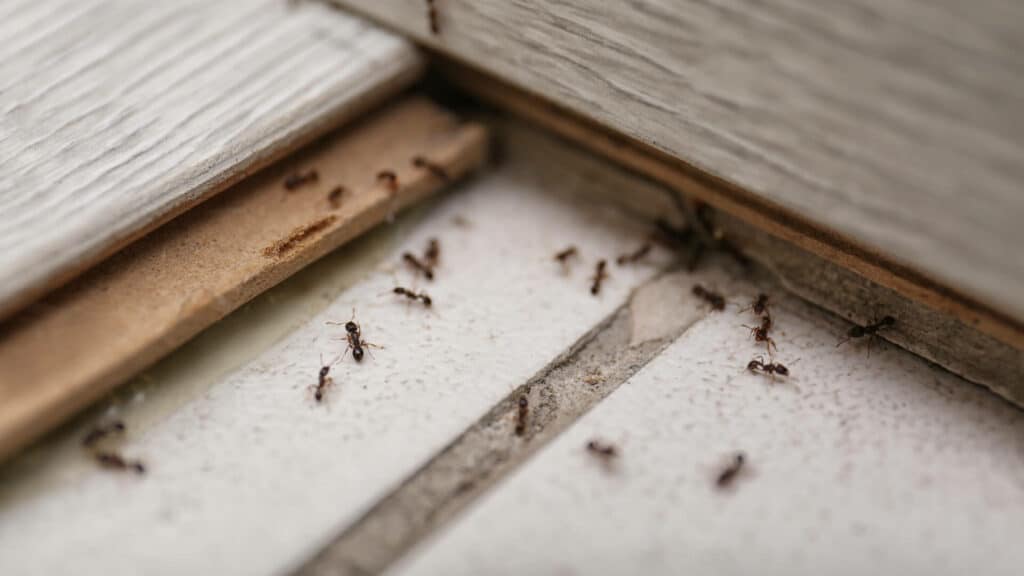
- Continuous ant trails and activity: You might notice persistent streams of ants following pheromone pathways between hidden nests and food sources, reappearing daily despite cleaning efforts indicating established foraging routes from active colonies.
- Indoor activity during winter: It’s concerning to find active ants indoors during cold months when outdoor colonies are dormant, suggesting nests established within heated wall voids or structural spaces where colonies remain active year-round.
- Winged reproductive ants appearing: You’ll likely observe winged ants (swarmers) emerging indoors, particularly in spring, indicating mature colonies producing reproductive individuals for establishing new colonies signaling serious established infestations.
- Structural damage or frass piles: You might discover sawdust-like material beneath wood, hollow-sounding timber, or visible galleries indicating carpenter ant colonies excavating nesting spaces causing property damage beyond nuisance concerns.
How to get rid of an ant infestation
Eliminating ant infestations requires comprehensive colony-targeting approaches rather than individual ant removal:
- Deploy colony-eliminating baits: Place slow-acting poison baits near ant trails allowing workers to transport toxins back to nests, killing queens and broods eliminating colonies’ reproductive capabilities rather than just visible foraging workers.
- Eliminate food and moisture sources: Clean thoroughly, store foods in sealed containers, fix water leaks, and remove attractants denying ants resources supporting colony growth and reducing their motivation for indoor foraging.
- Seal structural entry points: Caulk cracks in foundations, around utility penetrations, along baseboards, and around windows preventing ant access to indoor spaces from exterior nesting sites limiting indoor activity.
- Contact professional pest control services: Seek expert assistance for persistent infestations, structural damage, or difficult species like pharaoh ants requiring specialized treatment approaches locating and eliminating multiple nest sites simultaneously throughout structures.
When to contact the professionals
When dealing with ant problems throughout your property and need expert solutions for ant control, professional pest control services can provide comprehensive treatment strategies targeting source colonies. At Aptive, our pest control experts implement colony-elimination methods that address root causes rather than just visible symptoms of ant infestations.
If you’re experiencing persistent ant activity despite your control efforts, are dealing with difficult ant species like pharaoh ants that fragment when disturbed, don’t wait—contact Aptive today for a free quote for ant control.