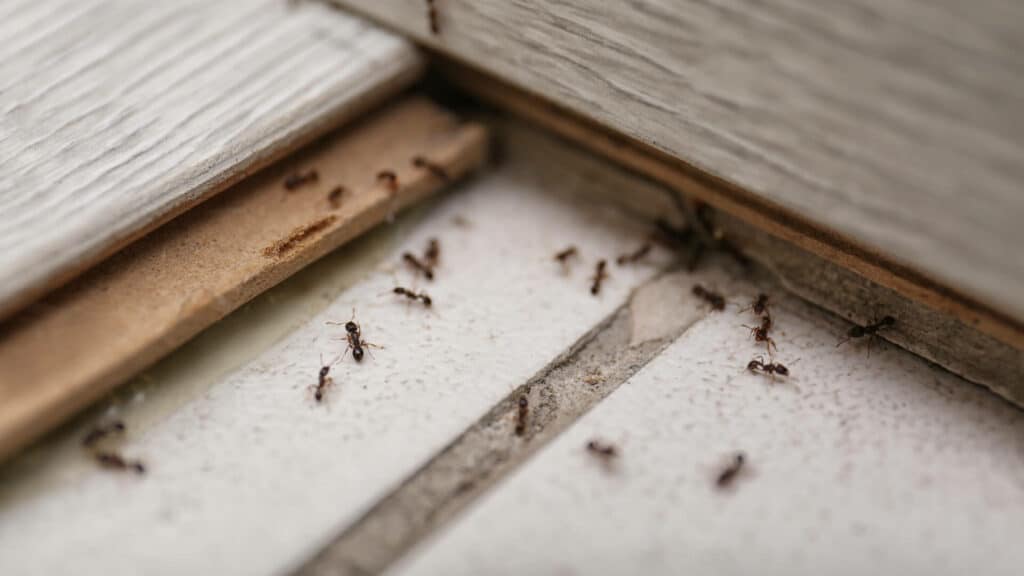
You observe ants creating temporary structures using their own bodies to span gaps, cross obstacles, or connect surfaces, demonstrating remarkable collective engineering capabilities without apparent planning or central coordination.
Certain ant species including army ants (Eciton and Dorylus genera), fire ants (Solenopsis invicta), and related species form living bridges—self-assembled structures where workers link together using tarsal claws and mandibles creating stable spans measuring 2-30cm length supporting continuous traffic of colony members transporting food, brood, or themselves across gaps that would otherwise impede colony movement or foraging efficiency.
These temporary structures represent extraordinary examples of collective behavior optimizing colony efficiency through coordinated physical cooperation.
How Ant Bridges Work
Living ant bridges form through self-assembly where individual workers respond to local mechanical forces and chemical cues, collectively creating structures balancing stability requirements against construction costs without blueprints or central direction.
Initial anchoring: Bridge formation begins when foraging workers encounter gaps including spaces between vegetation, across water, or over ground irregularities. Leading workers reaching gap edges halt at discontinuities, with trailing workers climbing over stopped individuals creating multi-layered accumulations at gap margins serving as bridge anchors.
Progressive extension: As workers continue crossing initial ant layers, some individuals grip substrate at gap edges while others extend bodies outward supported by anchored nest mates, with successive workers climbing across partially-formed bridges stopping when reaching unsupported ends, linking to bridge structure, and extending span further through accumulated body lengths.
Load-bearing mechanics: Individual ants grip nest mates using tarsal claws (on feet) and mandibles (jaws), creating mechanical connections capable of bearing 5-20 times individual body weight. Bridge structures distribute loads across multiple parallel chains of connected workers, with typical bridges containing 10-50 ants depending on span length and traffic volume.
Dynamic adjustment: Bridges continuously reconfigure as workers join or leave structures responding to mechanical stress signals. When bridge sections experience excessive tension (felt through stretched leg joints) or compression (detected through increased contact pressure), workers adjust positions or recruit additional ants, strengthening stressed areas and maintaining structural integrity.
Optimization principles: Research demonstrates bridges achieve near-optimal configurations balancing two competing factors—bridge shortness (reducing crossing time) versus bridge cost (number of workers committed to structure rather than other activities). Colonies naturally settle on compromise lengths typically 1-3 body lengths shorter than detour distances around gaps.
Why Ants Build Living Structures
Living bridge formation provides multiple survival advantages explaining why this energetically expensive behavior evolved despite committing significant worker numbers to structural rather than foraging roles.
- Time efficiency: Bridges reduce colony travel time across gaps compared to detours around obstacles. Army ant colonies raiding 100+ meters from bivouacs encounter dozens of gaps where bridges reducing crossing time by even 5-10 seconds per individual translate to hours of saved colony time across tens of thousands of worker trips.
- Load transport: Bridges enable workers carrying prey, brood, or leaf fragments to maintain grip on transported items while crossing gaps, preventing dropped loads requiring re-collection. This proves critical for army ants transporting immobilized but living prey that would escape if dropped.
- Traffic flow: Gaps without bridges create bottlenecks where workers accumulate at edges, with only occasional individuals successfully jumping gaps. Bridges enable continuous traffic flow maintaining 10-50 fold higher crossing rates preventing congestion that would slow colony-level foraging or migration.
- Predator avoidance: Bridges elevated above ground surfaces reduce exposure to ground-dwelling predators including spiders, centipedes, and predatory beetles that ambush ants traveling across soil, with elevated crossing routes providing defense advantage particularly important for species lacking powerful defensive chemicals or stings.
- Flood response: Fire ant bridge formation represents intermediate behavior toward floating raft construction, with gap-crossing behaviors adapted to water survival during flooding events common in their native South American habitats and introduced North American ranges.
The Secret to Insect Cooperation
Bridge formation emerges from individual workers following simple behavioral rules responding to local conditions rather than implementing colony-wide construction plans or receiving specific instructions.
Individual ants follow decision algorithms roughly approximating: “If crossing bridge and encounter unsupported end, link to structure and extend if local traffic rate exceeds threshold; if no recent crossings occur, detach and resume movement.” This creates bridges when traffic justifies construction costs but allows dissolution when gaps no longer require crossing.
Workers monitor crossing frequency through tactile encounters with passing nest mates. High traffic rates (>5-10 ants per second) signal gaps warranting bridge investment, while low traffic (<1 ant per second) suggests bridges should disassemble with constituent workers rejoining foraging or transport activities.
Individual ants sense structural stress through leg joint strain and contact pressure with neighbors. Excessive stress triggers reinforcement recruitment (through pheromone release or tactile signals), while low stress permits some workers to abandon structure, reducing unnecessary commitment of colony labor resources.
Despite appearing purposeful, bridge construction lacks colony-level design or supervision. Queens don’t direct construction, no worker coordinates overall structure, and no individual ant possesses information about total bridge dimensions or requirements. Complex structure emerges from distributed individual decisions.
What This Means for Pest Control for Ants
Living bridge formation exemplifies ant colony adaptability—rapidly overcoming obstacles through collective action without requiring time for learning or central planning. This adaptability extends to pest control contexts where colonies bridge over chemical barriers, rebuild trails around treated areas, and collectively overcome exclusion attempts through accumulated individual efforts.
If you’re experiencing persistent ant problems suggesting adaptive colony responses to control attempts, observing complex behavioral patterns including trail formation across treated areas, or dealing with species known for sophisticated collective behaviors, contact Aptive today for a free quote and expert evaluation from a pest control service implementing comprehensive ant control strategies.