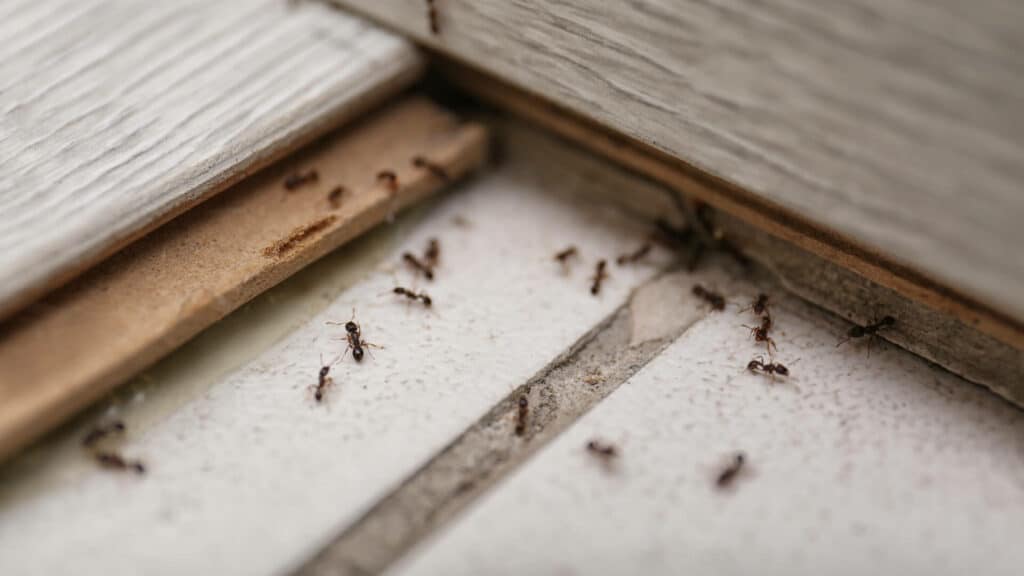
You observe ants clustering around or following trails leading to dead ant bodies, suggesting these insects respond to deceased colony members in seemingly-purposeful ways.
Ants follow dead ant trails because decomposing ant corpses release oleic acid—a specific fatty acid serving as a universal “death signal” triggering necrophoretic (corpse removal) behavior—which when overlapping with existing foraging pheromone trails creates conflicting chemical messages that confuse workers.
The pheromone ant communication systems enabling colony coordination also create situations where conflicting signals produce counterintuitive responses and where you might need ant control.
What Actually Happens When an Ant Dies
Ant corpses release oleic acid during decomposition, with this specific fatty acid serving as a hardwired death cue triggering consistent necrophoretic responses across diverse ant species.
- Chemical breakdown during decomposition: Following death, ant bodies undergo cellular breakdown releasing various fatty acids as cell membranes deteriorate. Among these compounds, oleic acid (a monounsaturated omega-9 fatty acid) appears approximately 2-3 days after death at concentrations high enough for ant detection, persisting throughout decomposition making it a reliable death indicator.
- Species-universal death signal: Research across numerous ant species demonstrates consistent recognition of oleic acid as death cue regardless of species, colony, or geographic origin. This universal response suggests ancient evolutionary origins, with oleic acid detection hardwired into ant nervous systems as innate behavior requiring no learning or experience.
- Necrophoretic response triggering: Oleic acid detection triggers specific behavioral sequences called necrophoresis—corpse removal behaviors where ants grasp dead individuals and transport them away from nest areas. This sanitation behavior prevents disease spread, reduces pathogen exposure to vulnerable broods and queens, and maintains colony hygiene critical for dense social insect colonies.
Why Other Ants Follow the Trail
Ants establish and maintain foraging trails through pheromone deposition, creating chemical pathways guiding colony members to food sources and back to nests.
- Trail pheromone deposition: Successful foragers returning to nests from food sources deposit trail pheromones from specialized glands (typically hindgut or poison gland depending on species) onto substrate surfaces. These chemical trails provide directional information enabling other workers to locate discovered resources efficiently without individual searching.
- Recruitment mechanism: Trail pheromones function as recruitment signals, with pheromone concentration correlating with food source quality and quantity. Rich food sources receive heavy marking creating strong trails attracting many workers, while poor sources receive light marking generating weak trails with minimal recruitment—an elegant decentralized decision-making system allocating colony foraging effort efficiently.
- Trail reinforcement and decay: Multiple workers traveling trails deposit additional pheromones strengthening pathways, while pheromone evaporation causes unrefined trails to fade within minutes to hours depending on species and environmental conditions. This creates dynamic trail networks emphasizing currently-productive resources while abandoning depleted sources.
Ants Are Always Following Chemistry
When oleic acid death signals overlap spatially with foraging trail pheromones, ants receive conflicting chemical messages creating confusion manifesting as clustering and investigation behaviors around dead individuals.
Overlapping chemical landscapes: Dead ants lying on or near active foraging trails create localized zones where oleic acid death signals overlap with trail pheromones. Workers approaching these zones detect both “food this way” messages from trail pheromones and “dead ant here” signals from oleic acid simultaneously, creating sensory conflict.
Behavioral confusion manifestations: Conflicting signals produce observable behavioral changes. Ants approaching mixed-signal zones slow movement and display increased antenna waving sampling air and surface chemistry more intensely, exhibit approach-avoidance behaviors alternately moving toward and backing away from sites, cluster around dead individuals as multiple workers investigate attempting to resolve signal ambiguity, and demonstrate longer-than-normal handling times before beginning corpse removal.
Signal prioritization attempts: Individual ants apparently attempt prioritizing signals based on concentrations and context. Strong trail pheromones may initially override weak oleic acid signals causing ants to walk over or near corpses without immediate response, while strong oleic acid from multiple corpses or advanced decomposition may eventually trigger removal behaviors despite ongoing trail followed by other workers.
Amplification through traffic: Active foraging trails experience high worker traffic, with dozens or hundreds of individuals passing specific points hourly. This traffic means dead ants on trails get encountered repeatedly, with each encounter potentially involving investigation behaviors that disturb corpses spreading oleic acid further and increasing subsequent workers’ signal detection likelihood.
Trail disruption effects: Dead ants physically obstruct trails creating movement bottlenecks where workers must navigate around obstacles. This forced contact increases oleic acid exposure while also potentially disrupting trail pheromone deposition patterns, compounding confusion as workers experience both chemical and physical disruptions simultaneously.
Why These Trails Don’t Always Go Away On Their Own
Professional pest control includes inspection identifying colony locations and entry points, species identification informing treatment selection, appropriate product application addressing colonies rather than just visible workers, sanitation and exclusion guidance preventing reinfestation, and monitoring confirming program success.
If you’re observing recurring dead ant accumulations, trails that persist despite cleaning, or strange ant habits including clustering around dead individuals suggesting chemical communication confusion, contact Aptive today for a free quote from a quality pest control service.