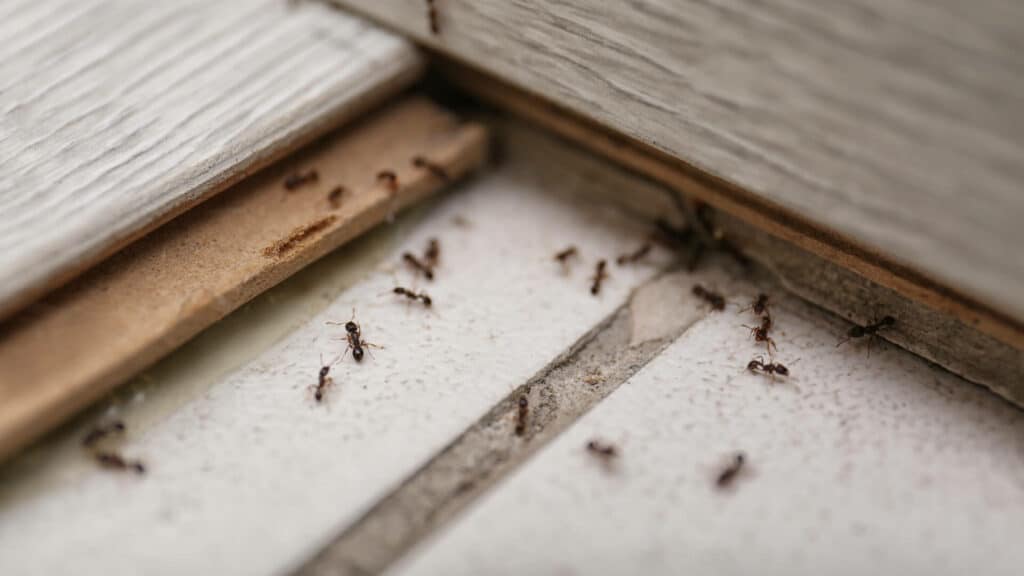
You’ve undoubtedly observed them: organized trails of pavement ants traversing your sidewalk, driveway, or patio spaces as if claiming territory. These persistent insects establish themselves around entryways, within concrete cracks, near waste disposal areas, and surrounding outdoor dining spaces.
Pavement ants demonstrate remarkable success in high-pedestrian areas, particularly during warmer seasons. When confronting recurring ant activity in your outdoor living spaces, addressing the underlying factors attracting these pests requires a more strategic approach to ant control.
Why Pavement Ants Choose High-Traffic Areas
Pavement ants gravitate toward environments that mirror human preferences for comfort and convenience. These industrious insects seek heat-retaining surfaces, accessible food sources, and adequate moisture—all readily available in areas with regular human activity. Concrete walkways and paved driveways effectively absorb and radiate solar heat, creating ideal thermal conditions for ant colonies.
Food availability represents another significant attractant in these high-traffic zones. Waste receptacles frequently contain food residues, outdoor dining areas generate inevitable crumbs, and beverage spills provide sugar sources as they penetrate porous paving materials. These combined factors create perfect foraging conditions.
The structural composition of paved surfaces offers additional advantages for colony establishment. Expansion joints, stress cracks, and spaces between pavers provide protected access to subterranean nesting sites while maintaining proximity to abundant resources. From these strategically located nests, worker ants can efficiently gather food throughout both day and night cycles, exploiting the continuous supply of organic material that human activity generates.
Where Pavement Ants Build Nests
Pavement ants construct extensive underground networks beneath hardscaped elements. Their excavation activities produce characteristic soil or sand deposits emerging from cracks in concrete, between paving stones, or along walkway edges. These small mounds of fine granular material serve as primary visual indicators of active nests beneath seemingly solid surfaces.
Their colony structures frequently extend beneath sidewalks, curbing elements, entrance steps, and driveway surfaces. While the central nest may remain invisible to casual observation, the presence of multiple small soil piles distributed along concrete seams provides reliable evidence of substantial underground development.
These highly territorial insects often establish multiple competing colonies within relatively close proximity. Neighboring colonies engage in boundary disputes, resulting in the unusual phenomenon of ant “wars” where workers engage in combat along territorial borders. This behavior explains the common observation of several distinct nesting sites existing just feet apart within the same paved area.
Colony placement typically favors locations adjacent to structural foundations—particularly where patios or walkways directly next to the home. This strategic positioning places them mere inches from potential interior entry points around kitchens or foundation openings.
How They Become a Problem
Pavement ant infestations create impacts extending beyond visible surface activity. Their extensive tunneling beneath concrete surfaces displaces supporting soil and sand, potentially contributing to uneven settlement, loose pavers, or surface instability over time. These subterranean passages may additionally create new water infiltration pathways under slabs, accelerating erosion processes or facilitating freeze-thaw damage in colder climates.
Their persistent presence disrupts outdoor living activities, particularly around waste collection areas, dining spaces, and pet feeding stations. What begins as occasional sightings often develops into daily encounters as colonies expand their foraging range and population density.
More concerning, exterior activity frequently transitions to interior invasion. Ant trails originating on outdoor surfaces often lead directly to structural access points including weep holes, door threshold gaps, utility penetrations, or foundation cracks. Once inside, these adaptable foragers efficiently locate kitchen areas, pantry spaces, or any location containing attractive food sources, particularly those providing proteins, oils, or sweet substances.
Why Standard Treatments May Not Work
Surface-applied household insecticide products may temporarily disrupt visible ant activity but typically fail to impact the underlying colony structure. Pavement ants nest deep beneath concrete elements, establishing complex tunnel networks that remain protected from topical applications. Eliminating visible foragers provides only momentary relief before the queen produces replacement workers that resume normal patterns.
These adaptable insects demonstrate remarkable behavioral flexibility when confronting obstacles. When established foraging routes face disruption through chemical barriers or physical modifications, colonies quickly establish alternative pathways. When one access point becomes inaccessible, workers locate secondary entry opportunities. This continuous learning and adaptation process explains why recurring activity in previously treated locations remains common despite initial control attempts.
Without directly addressing the central colony, including reproductive members and developing brood, control efforts remain largely ineffective. Sustainable management requires treatments capable of penetrating the protected nest environment and affecting the entire colony population through mechanisms that transfer throughout the social structure.
Why Professional Outdoor Pest Control Might Work Better
Effective management of pavement ants in high-activity outdoor zones requires specialized knowledge and targeted application techniques. Our pest control service delivers customized solutions based on each property’s unique characteristics and infestation patterns.
Request a free quote today to discover how our pavement ant management solutions and pest control can effectively restore comfort to your outdoor living spaces. Our experienced pest control technicians will evaluate your specific situation and develop a tailored treatment strategy addressing both current activity and prevention of future infestations.