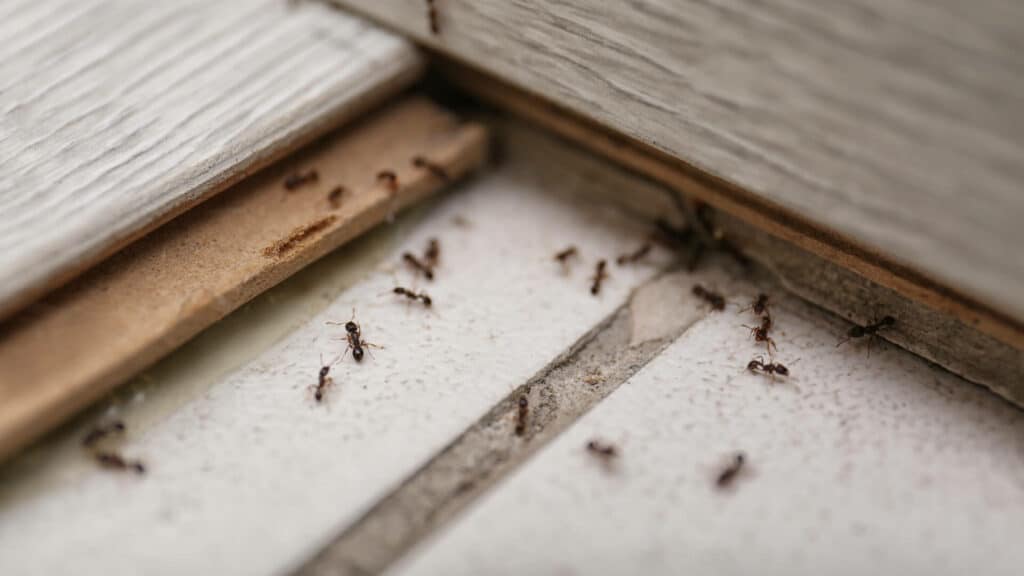
If you’ve observed hundreds or thousands of small brown ants moving in perfectly synchronized lines across your driveway, foundation, or indoor baseboards, you’re witnessing something remarkable. These Argentine ants aren’t randomly wandering—they’re demonstrating sophisticated communication networks that make them uniquely challenging among household pests. This coordinated behavior enables them to establish vast, interconnected colonies that can extend across entire neighborhoods.
Understanding this communication system is essential for effective Argentine ant control. While most homeowners focus on eliminating visible trails, successful management requires addressing the underlying networks that allow these ants to maintain their extraordinary social structures and resilience.
What Makes Argentine Ants Different
Argentine ants operate with fundamentally different social behaviors compared to most common ant species. While typical ants maintain competitive, territorially-defined colonies that actively defend against neighboring ant populations, Argentine ants demonstrate the opposite approach. They develop what entomologists call supercolonies—extensive cooperative networks where thousands of individual nests function together as a unified system rather than competing for resources.
These ants don’t merely tolerate neighboring nests from the same colony—they actively integrate with them. They share food resources, exchange worker ants, and cooperate in response to threats or opportunities. Your property might host numerous interconnected nests that maintain constant communication through shared trails and synchronized behaviors with colonies extending far beyond your property boundaries.
In warmer southern states and coastal regions, single Argentine ant supercolonies frequently encompass multiple properties—sometimes entire neighborhood blocks or more. This expansive colony structure creates significant challenges for conventional treatment approaches that target isolated nests or individual trails.
How They Communicate Across Distance
Argentine ants don’t communicate through sound—they rely on an intricate chemical communication network built entirely around pheromones. Worker ants continuously deposit specialized scent markers along their travel routes, with different chemical signals triggering specific behavioral responses: follow this path, gather food, defend this area, retreat from danger, or reorganize the colony structure.
These chemical trails undergo constant updates and modifications. When a food source becomes depleted, the corresponding trail gradually weakens as fewer ants reinforce it. When new resources are discovered, workers immediately strengthen that route with additional pheromones, creating a self-reinforcing pathway that other ants instinctively follow. If the colony detects potential threats or competition, it rapidly adjusts its entire trail network to prioritize defensive positioning or strategic redirection.
This sophisticated communication system explains their precisely coordinated movement patterns—forming lines that appear almost mechanical in their organization. It’s also how they successfully maintain operations across diverse environments including multiple properties, narrow structural gaps, interior wall voids, and landscaped areas without centralized control from a single visible queen.
Unlike many ant species, Argentine ant colonies typically maintain hundreds of reproductive queens distributed throughout their network. These queens move freely between connected nests, depositing eggs across numerous locations. This reproductive redundancy means the colony doesn’t collapse when individual queens are eliminated, making traditional nest-destruction approaches largely ineffective against their distributed colony structure.
What That Looks Like in and Around Homes
In practical terms, homeowners typically observe these distinctive behavioral patterns:
- Well-defined foraging trails extending from outdoor soil or mulch beds directly into your home—commonly entering through weep holes, expansion joints, siding gaps, or foundation cracks
- Activity levels that increase significantly during overnight hours or following rainfall events when changing moisture conditions motivate them to seek shelter within structural interiors
- Rapid accumulation around food preparation surfaces, pet feeding stations, or spills as worker ants efficiently communicate resource locations and quickly redirect colony resources
- Absence of visible central nests or mounds typical of other ant species, complicating both identification and targeted treatment efforts
You may also notice that disrupted trails quickly reform in identical locations after being physically removed or treated with household products. This persistent reestablishment demonstrates their pheromone network in action—ants that weren’t present during the initial disturbance can completely reconstruct the original pathway based on residual chemical signals that remain in the environment.
Why They’re Hard to Isolate
The expansive scale of Argentine ant supercolonies creates significant management challenges. Eliminating one visible section rarely impacts the broader system’s functionality. When one trail disappears through treatment, alternative pathways quickly develop to maintain resource access. When queens within one area are affected, others from connected nests readily assume reproductive responsibilities.
Their cooperative social structure creates remarkable resilience against localized control efforts. Their chemical communication network enables rapid adaptation to changing conditions. Combined, these factors explain why infestations frequently reappear after seemingly successful treatments—what appears inactive in one area may simply represent temporary redirection rather than actual colony elimination.
Argentine ants function less like isolated pest populations and more like interconnected systems. They expand opportunistically whenever favorable conditions arise, particularly during warmer seasons, around structural access points, or throughout properties with moisture-rich landscaping that provides ideal nesting conditions.
When to Talk to a Professional
Our pest control specialists understand the unique challenges presented by Argentine ant supercolonies. We employ advanced inspection techniques address not just visible activity but also the underlying network connections that you would likely miss. By identifying entry points, we develop targeted treatment strategies that address both immediate activity and the broader colony system.
Through our pest control service, we implement a tailored management program specifically designed to address Argentine ants’ unique characteristics while establishing effective barriers against recolonization.
Request a free quote today to discover how our Argentine ant management solutions can help eliminate these persistent invaders from your property. Our experienced technicians will assess your specific situation and develop a customized treatment strategy that addresses the colony network affecting your home.