You’ve probably heard this impressive ant fact repeated countless times: these tiny insects can lift objects weighing 50 times their own body weight. While this remarkable statistic might sound like an exaggerated nature documentary claim, it’s actually scientifically accurate—and represents far more than just an interesting conversation starter.
This extraordinary strength isn’t merely a fascinating biological curiosity. When ants decide to establish colonies in or around your home, their incredible lifting capacity becomes a significant practical problem that directly impacts the effectiveness of conventional pest control approaches. Understanding how ants utilize this strength helps explain why they’re such persistent invaders and why ant control often proves more challenging than homeowners initially expect.
The Science Behind Extraordinary Ant Strength
The claim about ant lifting capacity proves completely accurate—most ant species can indeed carry or drag objects weighing 10 to 50 times their body weight, with some exceptional species demonstrating even greater capabilities. This remarkable strength stems from fundamental principles of physics and biology that favor smaller creatures.
Ants possess exceptionally high ratios of muscle tissue relative to their total body mass, providing proportionally greater power output compared to larger animals. Their compact bodies dedicate significant space to muscle development rather than supporting bulk.
Their rigid external skeletons provide structural support that amplifies lifting capacity by distributing weight efficiently across their entire body framework. This external support system functions like built-in weight-lifting equipment.
Ant joints operate with limited range of motion but maximum efficiency, reducing energy waste during lifting and carrying activities. This mechanical optimization channels more power directly into useful work.
Smaller creatures naturally demonstrate higher strength-to-weight ratios due to the square-cube law—as size decreases, strength decreases more slowly than body mass, creating proportionally stronger smaller animals.
This incredible strength enables ants to perform remarkable feats including carrying food items many times their size, moving construction materials for nest building, engaging in combat with larger insects, and surviving in challenging environments where other insects would struggle.
Why That Strength Helps Ants Invade Your Home
When ants target your home, they’re conducting organized resource missions. Their exceptional strength provides multiple invasion advantages that most homeowners underestimate.
Ants can penetrate sealed food packaging, tear through plastic wrapping and cardboard containers, and systematically move debris to create nesting spaces within wall voids. Their carrying capacity enables efficient transportation of substantial crumbs and grease residues back to colonies, even when these items significantly outweigh individual workers.
They use their strength to excavate extensive tunnel networks beneath foundations and patios, moving surprising amounts of soil and debris. When working together, colonies can accomplish tasks hundreds of times beyond individual capacity, making their collective strength far exceed simple mathematical addition.
Which Ants Cause the Most Trouble at Home?
Different ant species demonstrate varying strength levels and utilize their capabilities in distinct ways that create specific challenges for homeowners. Understanding these differences helps identify which species you’re encountering and predict their likely behavior patterns around your property.
Odorous House Ants: These small but remarkably swift insects possess sufficient strength to transport sugar crystals, bread crumbs, and grease particles that far exceed their individual body weight. They commonly establish nests within wall voids, near hot water pipes, or inside insulation materials where their strength enables efficient tunnel construction and food storage.
Pavement Ants: Frequently encountered around driveways and patio areas, these ants demonstrate exceptional excavation abilities. They use their strength to move soil particles, concrete dust, and sand to create elaborate underground tunnel systems. Their strength enables them to clear substantial debris when expanding nesting areas beneath hardscaped surfaces.
Carpenter Ants: Among the largest common household ants, carpenter ants utilize their superior strength to excavate wooden structures—not for consumption, but to create nesting galleries. They can move surprisingly large wood fragments and debris, potentially causing significant structural damage over extended periods.
Argentine Ants: These highly organized invaders use their collective strength to establish extensive trail networks and rapidly transport discovered food sources back to multiple connected colonies. Their coordinated strength enables them to overwhelm competing ant species and dominate resource-rich areas.
Each species applies their strength differently, but all demonstrate remarkable persistence enabled by their lifting and carrying capabilities that far exceed what their size might suggest.
What You Can Do About It
While you cannot reduce ant strength, you can implement strategic modifications that minimize their advantages and make your home less attractive for invasion. Effective management requires understanding how their strength enables success and implementing appropriate countermeasures.
Key prevention strategies:
- Store all food in heavy-duty, airtight containers that exceed ant lifting capabilities.
- Fix water leaks immediately, as ants require moisture regardless of their strength.
- Seal entry points thoroughly with appropriate caulking materials.
- Implement comprehensive cleaning routines targeting small food particles ants can transport.
- Focus on areas beneath appliances and inside cupboards where crumbs accumulate.
- Consider professional assessment if ants persist despite prevention efforts.
These strategies address the specific advantages that ant strength provides during home invasion attempts.
Think You Might Have an Ant Problem?
When dealing with exceptionally strong ant problems in your home, Aptive’s pest control experts can help. Our technicians will perform a detailed inspection to assess the situation and develop a customized treatment plan based on the specific ant species and their strength capabilities.
Our pest control service will identify whether you’re dealing with carpenter ants that use their strength to excavate wood structures, or smaller species like odorous house ants that leverage their carrying capacity to efficiently transport food resources back to hidden colonies.
If you’re experiencing problems with ants that seem to overcome every barrier you create, contact Aptive today for a free quote. Our experts understand their incredible strength advantages and will recommend the most effective solutions to neutralize their capabilities and protect your home from these remarkably persistent invaders.
Commonly-Asked Questions About Ants
Here are some frequently-asked questions from homeowners about ants in the home.
Q: Are ants in the home dangerous?
Most household ants aren’t directly dangerous, but they pose health and property concerns. They can contaminate food surfaces and spread bacteria from outdoor sources. Carpenter ants cause structural damage by excavating wood, while fire ants deliver painful stings that can trigger allergic reactions. Some people experience allergic responses to ant proteins. Additionally, ants indicate entry points that other pests might exploit, making prompt elimination important for overall home protection.
Q: What is the strongest type of ant?
Carpenter ants and leafcutter ants are among the strongest ant species, capable of lifting 50+ times their body weight. However, strength varies by individual size and species. Driver ants and army ants also demonstrate exceptional collective strength. All ants possess remarkable strength-to-weight ratios due to their muscle structure and exoskeleton design. This strength enables them to carry food items much larger than themselves, move obstacles, and construct complex nests throughout your home’s structure.
Q: Where am I most likely to find ants in my home?
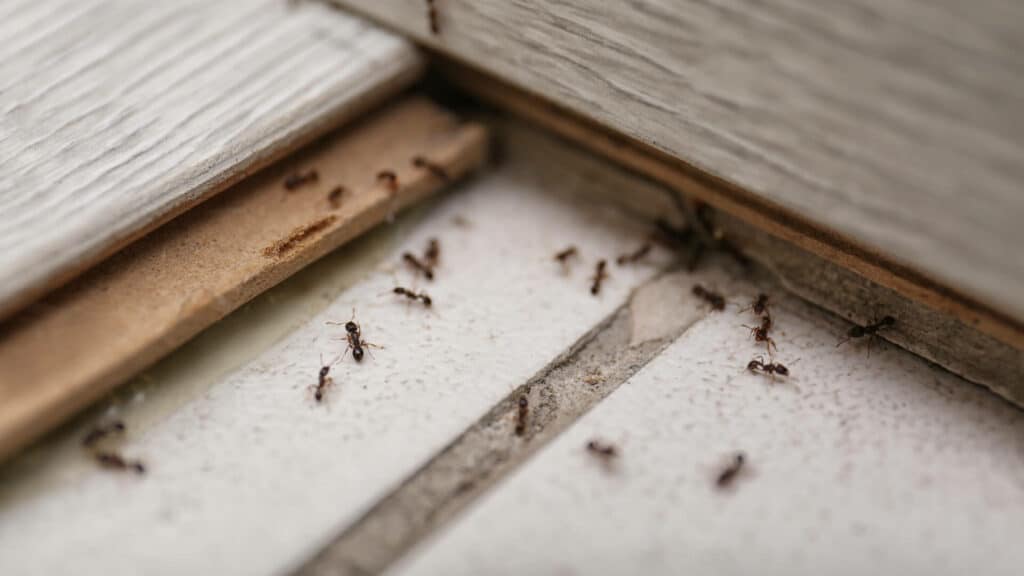
Ants typically appear in kitchens around food sources, near sinks and plumbing fixtures with moisture, along baseboards and wall edges where they travel, around pet food bowls and water dishes, in bathrooms with humidity and water access, and near entry points like doors, windows, and foundation cracks. They also frequent pantries, utility rooms, and areas with crumbs or spills. Look for them following consistent pathways between outdoor nests and indoor resources.