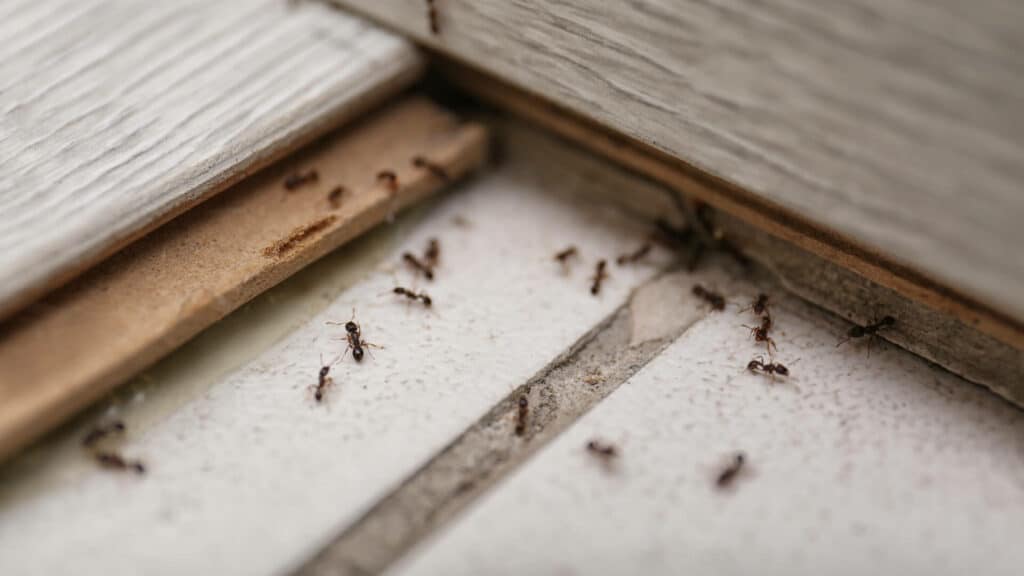
Distinguishing between stray ants and actual infestations requires evaluating multiple factors including frequency and consistency of sightings, presence of trails indicating pheromone-guided recruitment versus random wandering, location patterns, and species identification.
Understanding differences between stray ants and established infestations prevents both over-reaction to minor transient activity and underreaction to developing problems requiring prompt intervention. It also informs appropriate response strategies, and helps assess when professional ant control becomes necessary. Early accurate assessment enables timely intervention before minor problems escalate into major infestations.
Ant Foraging Behavior
Ant presence in structures reflects organized foraging systems driven by scout discovery, pheromone trail establishment, and worker recruitment, with activity patterns revealing whether presence represents exploration versus exploitation.
- Scout ant exploration: Colonies regularly dispatch scout ants exploring territories searching for new food and water sources. These scouts travel individually or in small groups investigating various locations, with most scouts finding nothing and returning to nests without establishing trails. Occasional isolated ant observations often represent these exploratory scouts.
- Trail establishment process: When scouts discover valuable resources, they return to colonies depositing trail pheromones guiding nestmates to discoveries. Initially, just a few workers follow trails verifying resource quality. If resources prove worthwhile, recruitment intensifies with dozens or hundreds of workers following established trails creating visible “ant highways.”
- Resource quality and recruitment intensity: High-quality abundant food sources trigger intense recruitment with heavy trail traffic and rapid resource exploitation, while marginal resources receive lighter recruitment with fewer workers. Observing trail intensity provides clues about whether ants found substantial rewards justifying continued exploitation versus minor discoveries generating minimal interest.
- Temporal dynamics: New trail establishment takes time, typically hours to days depending on species and resource value. Initial scout presence may appear minimal, but if resources remain accessible, activity increases as more workers recruit, creating an escalating presence over subsequent days.
- Species-specific foraging patterns: Different ant species demonstrate varying foraging strategies. Some species including Argentine ants maintain broad foraging territories with many simultaneous trails, while others including carpenter ants establish fewer more-focused trails. Understanding typical patterns for locally common species aids interpretation of observed activity.
Frequency and Consistency
The temporal pattern of ant observations—occasional isolated sightings versus regular repeated presence—provides critical information distinguishing transient activity from established exploitation.
Isolated single occurrences: Observing 1-2 ants on single occasions particularly in entry areas near doors or windows likely represents random scout exploration rather than infestation. These individuals may enter structures opportunistically through temporarily-open doors or small gaps, investigate briefly, then leave without establishing trails if no attractive resources are discovered.
Repeated daily sightings: Observing ants in same locations daily or multiple times daily indicates established trail systems with workers repeatedly traveling between colonies and discovered resources. This consistency suggests successful resource discovery justifying continued exploitation characteristic of actual infestations rather than transient exploration.
Increasing numbers over time: Progressive increases in observed ant numbers over days or weeks clearly indicates developing infestation as scout discoveries lead to recruitment and trail establishment. Even if initial observations showed just few individuals, escalating presence reveals successful colony establishment or resource exploitation warranting intervention.
Seasonal variation: Some ant species demonstrate seasonal indoor activity patterns with spring invasions common as colonies expand and fall entries occurring as outdoor conditions deteriorate. Seasonal presence returning annually suggests established nearby colonies regularly exploiting indoor resources, indicating recurring infestation problems rather than random events.
Trail Presence and Movement
Observing how ants move through spaces—following defined trails versus wandering randomly—reveals whether they follow established pheromone paths indicating infestation versus exploring unfamiliar territory.
Visible trail formation: Clear ant trails with multiple individuals following identical paths between points indicate established pheromone trails created through repeated worker traffic. These trails typically follow structural features including baseboards, counter edges, pipe runs, and wall-floor junctions providing navigation aids supplementing chemical signals.
Directional consistency: Ants on established trails demonstrate purposeful directional movement with workers traveling toward resources or returning to nests along defined routes. Random wandering with frequent direction changes and exploration behaviors suggests scout activity rather than trail-following indicating resource exploitation hasn’t yet begun.
Trail reinforcement observations: Watching specific trail segments over time reveals whether traffic increases (suggesting successful recruitment and developing infestation), remains stable (indicating ongoing exploitation of consistent resources), or decreases (suggesting resource depletion or successful disruption). Increasing trail traffic particularly indicates escalating problems.
Nesting Evidence
Direct evidence of ant nesting within or immediately adjacent to structures represents definitive proof of infestation rather than simple foraging from distant exterior colonies.
- Excavated material accumulation: Small piles of fine soil, sand, or sawdust-like material (frass) near cracks, expansion joints, or structural gaps indicate excavation activities creating or expanding nest chambers. These accumulations demonstrate actual nesting rather than just foraging presence.
- Swarmers and reproductive activity: Observing winged reproductive ants (alates or swarmers) indoors particularly during spring indicates nearby mature colonies producing reproductives. Indoor swarmer presence strongly suggests colonies within structures rather than exterior locations.
- Brood observation: Discovery of ant larvae, pupae, or eggs confirms nesting activity at discovered locations. While workers alone might represent foraging from distant colonies, brood presence definitively indicates reproductive colonies within structures.
- High-density aggregations: Extremely large numbers of ants concentrated in specific locations particularly in protected areas including wall voids, beneath insulation, or in structural voids suggests nest site proximity. While trails show dozens of workers, nest areas may contain hundreds or thousands of individuals.
- Species-specific nesting indicators: Different species demonstrate distinctive nesting patterns. Carpenter ants create sawdust piles from wood excavation, odorous house ants establish under objects on floors or in wall voids producing characteristic odor when disturbed, and pharaoh ants nest in extremely small protected spaces including behind baseboards or in electrical outlets.
What to Do If You Suspect a Larger Problem
Professional pest control provides accurate species identification determining infestation significance, inspection identifying colony locations and entry points, appropriate treatment selection based on species biology, and monitoring confirming successful elimination versus need for additional interventions.
If you’re wondering if you have an infestation based on patterns you’re observing, experiencing escalating ant presence despite basic interventions, or are uncertain about species identification and appropriate response, contact Aptive today for a free quote from a quality pest control service.