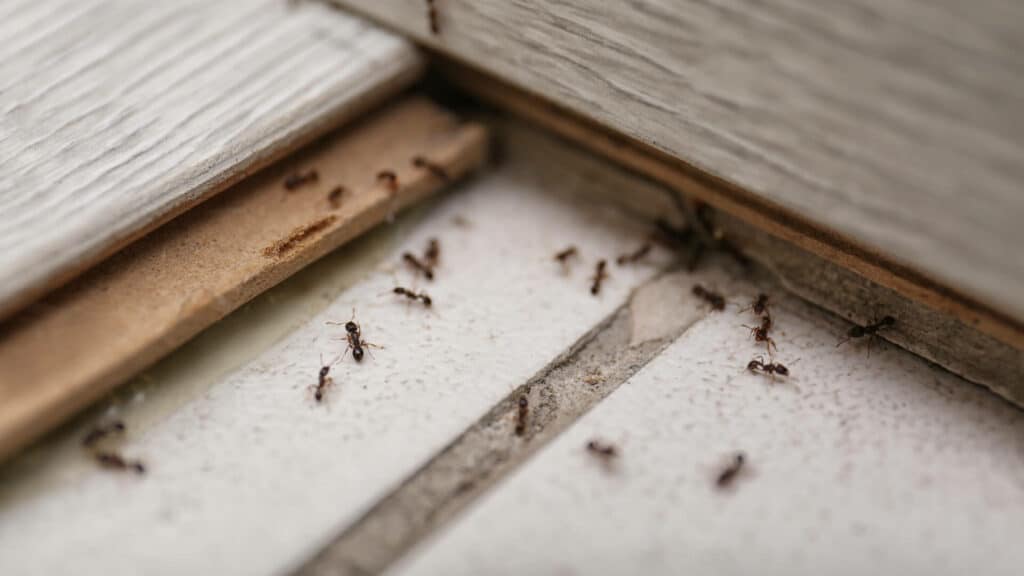
When discovering tiny yellow to light brown ants trailing indoors and attempting to distinguish between similar-appearing species, understanding the differences between thief ants vs pharaoh ants is crucial for implementing appropriate control strategies given their differing biology, behavior, and colony structures requiring species-specific management approaches.
Both ant species measure approximately 1.5-2.5mm body length creating identification challenges without magnification, both establish indoor colonies in concealed locations, both demonstrate polygyne (multiple-queen) colony structure, and both create persistent problems once established.
However, they differ significantly in taxonomic relationships, nesting strategies, reproduction methods, and dietary preferences. Understanding these distinctions enables accurate identification and informs ant control.
What Are Thief Ants?
Thief ants (Solenopsis molesta) belong to genus Solenopsiswithin subfamily Myrmicinae, making them close relatives of fire ants (Solenopsis invicta and related species) though lacking the aggressive stinging behavior and large colony sizes characteristic of fire ants.
Alternative common names include grease ant (reflecting dietary preferences) though this name applies to multiple species creating confusion. The “thief ant” designation derives from their characteristic nesting behavior near other ant species’ colonies, raiding those nests for brood (eggs, larvae, pupae) and food resources.
Thief ants rank among North America’s smallest ant species with workers measuring just 1.3-2.2mm body length (queens reach 5-6mm). Coloration ranges from pale yellow to light brown or brownish-yellow with a relatively uniform appearance. Their minute size—approximately equivalent to pen tip diameter—enables access through remarkably-small gaps and creates identification challenges requiring magnification for confident determination.
Thief ant colonies demonstrate polygyne structure containing multiple queens (typically 2-12 though higher numbers occur) enabling colony persistence if individual queens die and facilitating colony growth and reproduction. Colonies contain hundreds to several thousand workers (average 1,000-3,000 though colonies occasionally exceed 10,000 in favorable conditions). New colonies form through nuptial flights when winged reproductives (alates) emerge, mate, and queens establish new independent colonies—the typical ant reproductive pattern contrasting with pharaoh ant budding reproduction.
The defining thief ant behavioral characteristic involves their kleptoparasitic nesting strategy. They construct nests immediately adjacent to or interconnected with other ant species’ colonies, creating tunnels accessing host colonies then stealing brood and food stores.
This parasitic relationship provides ready food sources with minimal foraging risk. Common host species include larger ants like pavement ants, cornfield ants, and various Formica species. Indoor nesting occurs in wall voids, beneath flooring, behind baseboards, in insulation, around foundations, and various concealed protected locations. Outdoor nests occur in soil, under objects, in rotten wood, and near building foundations.
Thief ants demonstrate strong preference for protein-rich and fatty foods including dead insects, grease, cheese, meats, and pet food, though they consume sweets opportunistically. Their protein preference distinguishes them from many household ant species demonstrating stronger sugar preferences. Foraging workers establish chemical trails between nests and food sources recruiting nestmates to productive resources.
What Are Pharaoh Ants?
Pharaoh ants (Monomorium pharaonis) belong to genus Monomorium within subfamily Myrmicinae. Despite common names suggesting Egyptian origin, their actual native range remains uncertain though likely tropical Africa or Indo-Pacific region.
They’re named for early (erroneous) belief they represented one of biblical Egyptian plagues. Pharaoh ants achieved worldwide distribution through human commerce establishing as cosmopolitan pest species particularly problematic in temperature-controlled buildings.
Pharaoh ant workers measure 1.5-2.5mm length with queens reaching 3.5-5mm. Coloration is distinctive pale yellow to yellowish-red or orange-brown with abdomen noticeably darker (dark brown to nearly black) creating characteristic bicolored appearance. Under magnification, the three-segmented antennal club provides definitive distinction from thief ants.
Pharaoh ant colonies demonstrate extreme polygyny with hundreds to thousands of queens in mature colonies enabling extraordinary reproductive capacity and resilience. Total colony populations reach 300,000+ individuals though typically 1,000-2,500 workers.
The most-unusual and control-complicating characteristic involves budding reproduction where colony fragments containing queens, workers, brood, and sometimes food stores split from parent colonies establishing satellite nests while maintaining connections creating vast interconnected supercolonies. This asexual reproduction method (queens mate once before colony establishment then reproduce indefinitely from stored sperm) enables rapid colony proliferation without vulnerable nuptial flight periods.
Pharaoh ants demonstrate strong preference for heated indoor environments maintaining stable warm temperatures (27-30°C/80-86°F optimal) , rarely establishing outdoor colonies in temperate climates. They construct nests in wall voids, beneath flooring, in insulation, around hot water pipes, in appliances, within electrical equipment, and numerous other warm protected locations.
A single property may contain dozens to hundreds of interconnected satellite nests creating distributed supercolony structure. Their particular prevalence in hospitals, nursing homes, food facilities, and multi-family housing reflects both their environmental preferences and control difficulties in complex structures.
Pharaoh ants demonstrate an omnivorous, generalist diet consuming a wide range of foods including sweets (sugars, syrups, honey), proteins (meat, cheese, dead insects), fats and oils, various processed foods, and even blood and wound drainage in medical facilities. This dietary flexibility enables exploitation of diverse food sources supporting colony growth in various environments.
The Main Difference Between Ant Species
While both species rank among smallest household ants, slight size differences exist. Thief ants measure 1.3-2.2mm (workers) representing the absolute smallest end of household ant size range. Pharaoh ants at 1.5-2.5mm demonstrate slightly larger average size though substantial overlap exists preventing reliable size-based identification without numerous specimens for comparison.
Color provides more-reliable field distinction. Thief ants appear relatively uniform pale yellow to light brown throughout their body. Pharaoh ants demonstrate characteristic bicolored pattern with pale yellow to orange-brown head and thorax contrasting with distinctly-darker brown to black abdomen. This abdominal darkening, when visible, suggests pharaoh ants though young workers may show less-distinct patterns.
Under magnification, antennal club segmentation provides definitive identification. Thief ants possess two-segmented clubs while pharaoh ants demonstrate three-segmented clubs. However, this requires specimen collection and magnification equipment unavailable to most homeowners making professional pest control valuable.
Range considerations inform identification probability. Pharaoh ants occur throughout North America wherever heated buildings exist showing no geographic limitations. Thief ants demonstrate broader outdoor distribution in southern states becoming increasingly restricted to indoor environments in northern regions, though they occur nationwide. Indoor observations of either species can occur anywhere.
Behavior and Ecological Differences
The most-profound behavioral difference involves nesting strategies. Thief ants’ kleptoparasitic nesting near host ant colonies represents a specialized ecological niche exploiting other ants’ resources.
This strategy proves effective outdoors where diverse ant species provide potential hosts but may limit indoor establishment where host colonies may be absent. Pharaoh ants construct independent colonies without parasitic relationships demonstrating greater habitat flexibility and easier indoor establishment.
Reproductive method differences dramatically affect control difficulty and infestation dynamics. Thief ants reproducing through nuptial flights demonstrate more-traditional colony establishment with founding queens creating new independent colonies following mating.
This limits colony proliferation rate and creates vulnerable dispersal periods. Pharaoh ants’ budding reproduction enables rapid colony multiplication without vulnerable flights, creates interconnected colony networks complicating elimination, and represents the primary reason pharaoh ants rank among most-difficult household ants to control.
Both species establish chemical trails recruiting nestmates to food sources though pharaoh ants demonstrate more-extensive trail networks given larger colony sizes and budding-driven distribution. Thief ants may maintain closer nest-to-food distances given nest placement near resources. Both forage primarily during evening and nighttime hours though pharaoh ants demonstrate more-consistent activity patterns.
Critically, the species respond differently to nest disturbance. Thief ant colonies disturbed or treated may relocate but typically maintain colony integrity. Pharaoh ant colonies disturbed often fragment through stress-induced budding with multiple queens and worker groups departing establishing numerous satellite colonies—a phenomenon making improper treatment counterproductive actually spreading rather than eliminating infestations.
Health and Economic Risks
Both species create contamination concerns foraging in unsanitary areas then accessing food preparation and storage locations. Pharaoh ants pose particular health risks in healthcare facilities entering IV lines, wound dressings, and sterile supplies while mechanically vectoring various bacteria including Salmonella, Staphylococcus, Streptococcus, and Pseudomonas. Their presence in hospitals represents serious infection control concern. Thief ants similarly contact garbage and decaying materials then contaminate food surfaces though typically demonstrate less healthcare-specific concern.
Both species contaminate stored foods, food preparation surfaces, and serving areas through physical presence and associated bacteria. Economic losses from discarded contaminated foods, professional pest control costs, and reputation damage (particularly in food facilities) prove substantial.
Pharaoh ants’ nesting in electrical equipment creates equipment malfunction risks, potential short circuits, and even fire hazards. Both species nesting in walls and insulation create sanitation concerns from accumulated waste, dead ants, and associated microorganisms.
Why You Might Need a Professional
- Why professional control proves essential: Both species demonstrate characteristics making effective DIY control extremely difficult including small size enabling access through tiny gaps making exclusion challenging, cryptic nesting in concealed inaccessible locations, large populations in mature colonies, and for pharaoh ants specifically budding reproduction triggered by improper treatments. Professional expertise in species identification, appropriate product selection, and strategic application proves essential for successful elimination.
- Species-specific control approaches: Thief ants respond to integrated approaches combining baiting with slow-acting protein-based baits transferred throughout colonies, residual insecticide applications to likely foraging routes, sanitation eliminating food sources, and when possible addressing nearby host ant colonies they’re parasitizing.
Pharaoh ants require specialized baiting programs using slow-acting toxicants in attractive protein and sugar baits enabling transfer throughout interconnected colony networks before toxicity manifests, avoiding contact insecticides and nest treatments triggering stress budding, and sustained multi-week treatment programs addressing successive colony generations.
- Prevention strategies: Both species control benefits from exclusion through sealing entry points though their minute size makes complete exclusion nearly impossible, sanitation through proper food storage and prompt cleanup, moisture control through leak repair and humidity reduction, and monitoring through regular inspection enabling early detection before major establishment.
Get Professional Ant Pest Control
Given identification difficulties distinguishing these similar tiny species and the critical importance of species-appropriate control strategies, professional ant pest control provides valuable services including accurate species identification. If you’re observing tiny yellow to brown ants indoors, uncertain whether dealing with thief ants vs pharaoh ants, or experiencing persistent problems despite control attempts, contact Aptive for free quote and professional evaluation from a quality pest control service.