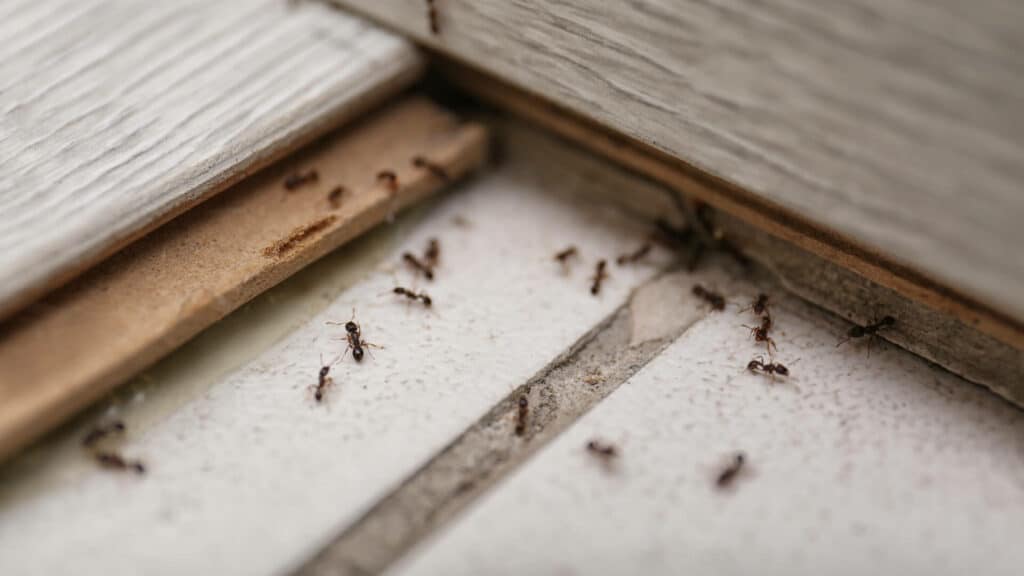
Ant stingers represent modified egg-laying organs evolved into powerful venom-delivery weapons found in numerous ant species worldwide, capable of inflicting painful defensive stings ranging from minor irritation to excruciating pain requiring medical attention.
Unlike biting ants that use only their mandibles for defense, stinging ants possess specialized anatomical structures injecting venom through sharp, needle-like appendages at their abdomens’ tips.
Understanding which ant species have stingers, how these structures function, and the varying potency of ant venoms helps identify potentially dangerous species and implement appropriate caution and ant control when encountering unfamiliar ants.
What are ant stingers?
Ant stingers are modified ovipositors—originally egg-laying organs—that evolved into venom-injection structures in certain ant subfamilies, located at the tip of the abdomen and capable of penetrating skin to deliver painful defensive venoms.
Only female ants possess stingers since these structures derive from female reproductive anatomy, with males and species lacking stingers relying exclusively on biting with their mandibles for defense. The stinger consists of a sharp, hollow stylet connected to venom glands producing various toxic compounds including proteins, peptides, and alkaloids causing pain, tissue damage, and allergic reactions.
Stinging ants retain their stingers after use unlike honeybees that lose their barbed stingers, allowing ants to sting repeatedly. Approximately 9,500 ant species across several subfamilies possess functional stingers, representing a significant minority of the 13,000+ known ant species worldwide.
Why do ants have stingers?
Ants evolved stingers primarily for defense against predators, rival ant colonies, and threats to their nests, with venom serving as an effective deterrent against vertebrate and invertebrate enemies that might consume ants or destroy colonies.
Stinging provides immediate, painful consequences discouraging future attacks by predators that learn to avoid stinging ant species through negative reinforcement. Some ant species also use stingers offensively when hunting prey, subduing insects and other arthropods with paralytic or lethal venom injections.
The evolutionary transformation of egg-laying organs into weapons represents a successful adaptation allowing stinging ants to defend resources, territories, and vulnerable broods more effectively than non-stinging species relying solely on biting. This defensive advantage has contributed to the ecological success and global distribution of stinging ant subfamilies including fire ants and harvester ants.
How do ant stingers work?
Ant stingers function through a coordinated anatomical system where ants grip targets with their mandibles, curl their abdomens forward, and thrust sharp stylets through skin while simultaneously contracting muscular venom glands that force venom through hollow stinger channels into victims’ tissues.
The stinger itself consists of a rigid stylet with a sharp tip capable of penetrating skin, connected to a venom reservoir and muscular glands that actively pump venom during stinging. Unlike passive venom delivery, ants control venom quantity injected through muscular contractions, potentially delivering multiple doses during prolonged stings.
Chemical compounds in ant venoms include alkaloids causing burning pain, peptides producing tissue damage and inflammation, and proteins triggering allergic reactions ranging from localized swelling to potentially fatal anaphylaxis in sensitized individuals. The ability to sting repeatedly without losing stingers makes ant stings particularly problematic during mass attacks by swarming species.
Which types of stinging ants are the most dangerous?
The most dangerous stinging ants include bullet ants causing the world’s most painful insect sting, bull ants and jack jumper ants responsible for fatal allergic reactions in Australia, and fire ants whose aggressive swarming behavior results in thousands of emergency room visits annually.
Bullet ants deliver excruciating 12-24 hour pain episodes, while Australian bull ants and jack jumpers cause more anaphylactic deaths than bees or wasps in their native range due to potent allergenic venoms. Fire ants pose widespread danger through mass attacks injecting cumulative venom doses, particularly threatening to young children, elderly individuals, and those with mobility limitations unable to escape swarming workers.
Types of ants with stingers
Numerous ant species across several subfamilies possess functional stingers, with the most medically significant stinging ants including fire ants, bullet ants, harvester ants, and various Australian species known for particularly painful or dangerous stings.
Stinging ants inhabit diverse environments from tropical rainforests to arid deserts, with venom potency, pain levels, and medical significance varying dramatically between species. The following species represent some of the most notable and dangerous stinging ants encountered by humans worldwide.
Fire ants
Fire ants, including red imported fire ants (Solenopsis invicta) and native fire ant species, are small reddish-brown to black ants measuring 1/8 to 1/4 inch with aggressive swarming behavior and painful alkaloid-based venom causing characteristic burning sensations and pustule formation.
These invasive ants attack en masse when colonies are disturbed, with individual ants biting to anchor themselves before stinging repeatedly, injecting venom that creates intense burning pain and distinctive white pustules appearing within 24 hours.
Fire ant venom contains primarily piperidine alkaloids rather than protein-based venoms, causing sterile pustules and potential allergic reactions in sensitized individuals. Their aggressive territorial defense and massive colony sizes make fire ants medically significant pests throughout the southern United States and other invaded regions worldwide.
Bullet ants
Bullet ants (Paraponera clavata) are large reddish-black ants measuring up to 1 inch found in Central and South American rainforests, infamous for delivering the most painful insect sting in the world, described as causing waves of intense, debilitating pain comparable to being shot.
Their venom contains poneratoxin, a powerful peptide affecting sodium channels and causing extreme pain lasting 12-24 hours without significant tissue damage or lasting harm despite the excruciating experience.
Indigenous people in some regions use bullet ant stings in initiation rituals requiring young men to endure multiple stings demonstrating courage. Despite their fearsome reputation, bullet ants are not particularly aggressive unless nests are threatened, preferring to flee when possible and reserving stings for defensive purposes when escape isn’t feasible.
Bull ants
Bull ants (Myrmecia species) are large, aggressive Australian ants measuring 1/2 to 1 inch with powerful mandibles and potent stingers, known for particularly painful stings and causing more allergic reactions and anaphylactic deaths in Australia than any other insect including bees and wasps.
These primitive ants possess excellent vision, actively pursuing intruders near their nests with aggressive charges and delivering painful stings using protein-rich venom causing intense burning pain, significant swelling, and potential severe allergic reactions.
Bull ant venom contains various allergens triggering hypersensitivity in some individuals, making repeated stings increasingly dangerous for sensitized people. Their combination of aggressive behavior, powerful stings, and allergenic venom makes bull ants among Australia’s most dangerous invertebrates despite their ecological importance as predators.
Jack jumper ants
Jack jumper ants (Myrmecia pilosula) are distinctive Australian jumping ants measuring 1/2 inch with orange-brown and black coloring, capable of jumping significant distances and delivering stings causing severe allergic reactions more frequently than other ant species worldwide.
These ants are responsible for more medically significant allergic reactions in Tasmania than bees and wasps combined, with their venom containing potent allergens triggering anaphylaxis in approximately 3% of the Tasmanian population.
Jack jumper stings cause immediate sharp pain followed by localized swelling, though sensitized individuals experience life-threatening systemic reactions including breathing difficulties, rapid blood pressure drops, and loss of consciousness. Effective immunotherapy treatments are available for jack jumper allergies, reducing reaction severity in sensitized individuals through controlled venom exposure.
Graceful twig ants
Graceful twig ants (Pseudomyrmex gracilis) are slender, elongated ants measuring 1/4 inch found in Central and South America, living symbiotically in hollow plant stems and defending host plants aggressively with painful stings protecting against herbivores.
These ants patrol host plants continuously, attacking any disturbance with coordinated stinging responses that protect plants from browsing animals and competing vegetation. Their venom causes immediate sharp pain and localized inflammation, though effects remain less severe than bullet ants or fire ants.
Graceful twig ants represent mutualistic relationships where plants provide shelter and food while ants provide aggressive defense, demonstrating evolutionary partnerships between stinging ants and their plant hosts throughout tropical ecosystems.
Panther ants
Panther ants (Neoponera species, formerly Pachycondyla) are large, dark-colored tropical ants measuring 1/2 to 3/4 inch with powerful stings causing intense pain, found throughout Central and South America, Africa, and Southeast Asia in forested habitats.
These solitary or small-colony hunters use their stings both defensively and offensively when subduing large arthropod prey, delivering venom that causes immediate sharp pain followed by prolonged throbbing and swelling lasting several hours to days.
Panther ant stings rank among the more painful ant stings globally, though they fall below bullet ants on pain intensity scales. Their relatively non-aggressive nature means stings typically occur only during accidental encounters when ants are stepped on or handled unintentionally.
Little fire ants
Little fire ants (Wasmannia auropunctata) are tiny invasive ants measuring only 1/16 inch with painful stings disproportionate to their minute size, causing intense burning sensations and forming welts despite being among the world’s smallest stinging ants.
These tropical invaders form massive supercolonies displacing native species throughout Hawaii, the Caribbean, West Africa, and Pacific islands, creating ecological damage while inflicting painful stings on humans and animals. Their venom causes prolonged burning pain lasting hours, with welts persisting for days or weeks in some individuals.
Little fire ants blind and kill domestic animals through repeated stings to eyes and sensitive tissues, making them serious veterinary concerns in invaded regions beyond their nuisance impacts on human populations.
When to talk to a professional
If you are dealing with stinging ant problems around your home, professional pest control services offer the most effective solutions, especially for aggressive species like fire ants that can pose serious safety risks through swarming attacks. Our pest control technicians will perform a detailed inspection to assess the situation, making recommendations for a targeted and effective solution.
Given the potentially serious safety consequences of stinging ant encounters, particularly for individuals with venom allergies or sensitivities, attempting DIY control of large colonies is strongly discouraged. If you’re experiencing problems with stinging ants, have discovered aggressive colonies near high-traffic areas, or need expert assistance protecting your family and pets from painful or dangerous ant stings, contact Aptive today for a free quote.